

Quick answer:
Before accepting a therapy practice sale offer, compare the amount and certainty of cash at closing, not just the headline price. Then test the working-capital adjustment, contingent payments, rollover equity, post-closing job, legal exposure, exclusivity period, transition workload, and the buyer’s operating plan for clinicians and clients.
A lower offer can be better if more of it is paid at closing and the seller retains less risk. A higher offer can be better if its future value is realistically achievable and the buyer’s terms protect the practice. The right answer depends on your priorities, the exact documents, and advice from qualified legal and tax professionals. Legal and tax treatment varies by state, entity, transaction structure, and seller circumstances.
Why can the headline price overstate a therapy practice sale offer?
The headline usually describes enterprise value or total potential consideration. It may not equal the money available to you on closing day. Debt repayment, transaction expenses, taxes, escrow, working-capital adjustments, seller financing, and payments tied to future results can materially change what you receive and when.
Start with a payment waterfall. For each offer, show the stated value, cash paid at close, amounts withheld, debt and debt-like items, fees, expected working-capital adjustment, and every deferred or contingent component. Have your tax advisor model after-tax proceeds rather than assuming two offers with the same price have the same tax result.
Structure matters. In an asset sale, the buyer purchases specified assets and assumes only identified liabilities; in an equity sale, the buyer purchases ownership interests in the entity, which generally continues to hold its assets and liabilities. Those are simplified definitions, not conclusions about a specific deal. Contract assignment, payer enrollment, licensure, historical liabilities, and taxes can differ significantly.
For certain asset acquisitions, buyer and seller must report the agreed allocation among asset classes on IRS Form 8594. That allocation can affect the character and timing of the seller’s taxable gain, so it should not be left until the closing checklist.
How should you compare two offers in practice?
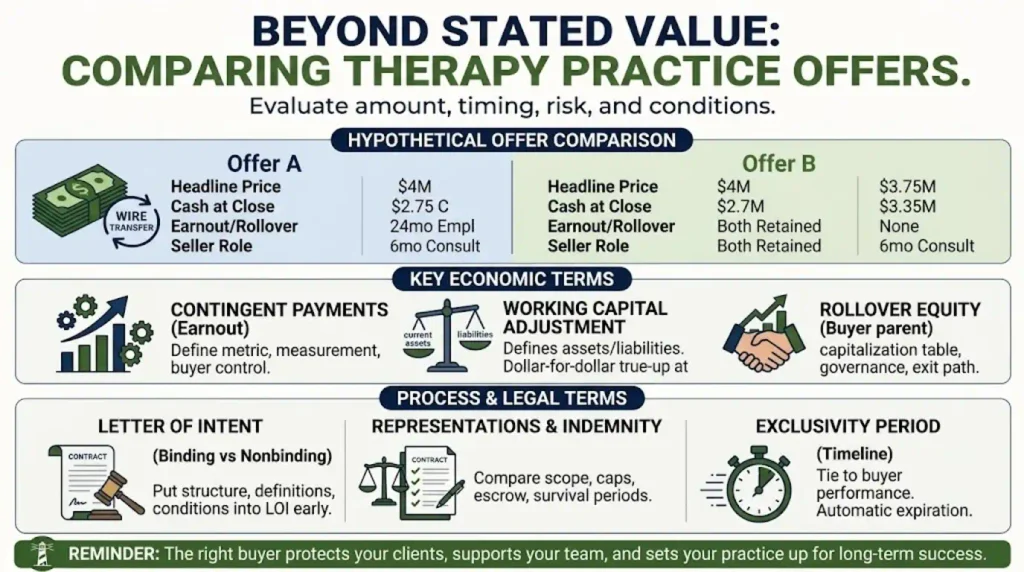
The following example is hypothetical. It is a teaching scenario, not a valuation indication, client story, market benchmark, or prediction of proceeds. Taxes, fees, debt payoff, and any working-capital true-up are excluded.
| Term | Hypothetical Offer A | Hypothetical Offer B | Seller-side reading |
| Headline consideration | $4,000,000 | $3,750,000 | A appears $250,000 higher. |
| Cash paid at close | $2,700,000 | $3,350,000 | B delivers $650,000 more immediately. |
| Escrow or holdback | $200,000 for 18 months | $250,000 for 12 months | Compare release conditions, claims rights, and survival periods. |
| Earnout | Up to $500,000 over two years | None | A’s full price requires future performance. |
| Rollover equity | $600,000 in buyer parent | None | A retains investment risk and possible upside. |
| Seller note | None | $150,000 over three years | B makes the seller a creditor; review security and subordination. |
| Working-capital target | $300,000; dollar-for-dollar true-up | Target set after diligence | B leaves a material price mechanic unresolved. |
| Seller role | 24-month employment; operating targets | Six-month consulting transition | Time, authority, termination rights, and pay differ sharply. |
| Exclusivity | 90 days plus buyer extension | 60 days with defined milestones | A keeps the practice off market longer. |
| Culture plan | Centralize intake and scheduling at close | Local model for 12 months; review thereafter | Ask what changes in supervision, caseload, compensation, and access. |
Offer A’s components total $4,000,000, but only $2,700,000 is scheduled as cash at close. Offer B’s components total $3,750,000, with $3,350,000 scheduled at close. Neither is automatically superior. The owner who wants a clean retirement may prefer B. An owner who understands the rollover investment and wants continued upside may prefer A. Both still require full legal, tax, financing, and operational diligence.
Which economic terms deserve the closest review?
How much cash will actually arrive at closing?
Ask for a draft sources-and-uses schedule. It should identify purchase consideration, buyer financing, assumed or repaid debt, transaction expenses, escrow, estimated adjustments, and the amount wired to the seller. Confirm whether “cash at close” is before or after these deductions. If financing is a condition, ask for lender evidence and a financing timetable.
If a buyer proposes SBA-backed financing, identify the exact program and lender rather than treating “SBA eligible” as funding certainty. The SBA explains that 7(a) loans may be used for changes of ownership, but participating lenders make credit decisions and impose program and underwriting requirements. Current policy is maintained through SBA’s SOP 50 10 materials and can change over time.
What is contingent consideration?
Contingent consideration is purchase value paid only if stated future conditions are satisfied. An earnout is contingent consideration tied to post-closing performance, such as revenue, earnings, collections, or clinician retention.
Read the formula, not the label. Define the metric, measurement period, accounting rules, excluded costs, treatment of acquisitions, staffing decisions, payer changes, calculation access, dispute process, and what happens if the buyer sells or terminates the seller. If the buyer controls spending, intake, clinician compensation, or integration, it may also control the outcome.
How does the working-capital target change proceeds?
Working capital is the short-term operating asset-and-liability balance delivered with the business under an agreed definition. In therapy deals, the definition may include accounts receivable and selected current liabilities, with exclusions negotiated for cash, debt, taxes, owner items, or aged receivables.
The target is often compared with actual working capital at closing. In a simple hypothetical dollar-for-dollar true-up, a $300,000 target and $220,000 delivered amount would reduce proceeds by $80,000. The hard part is not subtraction; it is defining each account, the measurement rules, and a normal level for a seasonal or growing practice.
What does rollover equity really buy?
Rollover equity is sale consideration reinvested into the buyer’s or post-closing company’s ownership. It is not cash and should not be valued as if it were immediately liquid.
Request the capitalization table, entity and security class, governing documents, debt structure, distribution policy, information rights, dilution protections, transfer restrictions, repurchase rights, tax treatment, and expected exit path. Ask whether management, founders, and the financial sponsor own the same class on the same economic terms. Future value can rise, fall, or remain unavailable for years.
Are employment and consulting terms separate economics?
Yes. Purchase price compensates you for the business; employment or consulting pay compensates you for future work. Keep them separate when comparing offers.
Specify role, schedule, location, authority, reporting line, compensation, benefits, term, termination rights, malpractice coverage, and duties connected to an earnout. A two-year job with little authority can be a poor fit even when the salary looks reasonable. A short consulting period can still be demanding if the agreement requires broad availability, clinician retention, payer support, referral introductions, or problem resolution without limits.
Which legal and process terms can change the value of the deal?
What does the LOI commit you to?
A letter of intent (LOI) is a preliminary document that states the proposed transaction economics and process before definitive agreements. Many business terms may be described as nonbinding, while provisions such as confidentiality, exclusivity, access, expenses, and governing law may be binding. Counsel should review the actual wording before signature.
Do not leave major issues to “customary terms.” Put the structure, price mechanics, working-capital definition, contingent consideration, rollover, seller role, financing conditions, diligence scope, restrictive covenants, and closing conditions into the LOI with enough precision to expose disagreement early.
How should sellers read representations and indemnity?
Representations and warranties are factual statements the parties make in the purchase agreement about matters such as authority, financials, contracts, billing, workforce, privacy, licensure, taxes, and disputes. Indemnity provisions allocate responsibility for specified losses if those statements are inaccurate or covenants are breached.
Compare the scope of statements, knowledge qualifiers, materiality standards, disclosure schedules, survival periods, claim threshold or basket, liability cap, escrow, exclusions, and special indemnities. Also ask whether the buyer can recover the same alleged loss through multiple mechanisms, such as a purchase-price adjustment and an indemnity claim. These are legal terms with state-specific consequences; healthcare transaction counsel should negotiate them.
Is the noncompete reasonable and enforceable?
A noncompete is a contractual restriction on specified competitive work or business activity after the relationship ends. The FTC’s 2024 nationwide rule did not take effect and was vacated; the FTC has continued to describe case-by-case enforcement against unlawful noncompetes. State law and the distinction between employment and sale-of-business covenants remain critical. Review duration, geography, restricted services, passive investments, termination scenarios, and professional obligations with counsel.
How much exclusivity should you grant?
Exclusivity prevents the seller from soliciting or negotiating with other buyers for a stated period. It gives the buyer time to spend money on diligence and documentation, but it also removes the seller’s leverage.
Tie exclusivity to a realistic diligence plan, document deadlines, proof of financing, decision-maker access, and automatic expiration. Be cautious about open-ended extensions controlled only by the buyer. Ask what happens if the buyer changes price, adds a financing condition, or misses milestones.
How do you evaluate transition duties, culture, and continuity?
Transition language should state what the seller must do, for how long, under whose direction, and with what authority. List introductions, payer and credentialing support, clinician communications, referral handoffs, lease or vendor consents, EHR migration, and leadership training. Avoid a vague promise to provide “all assistance requested.”
Privacy duties need a specific plan. HHS includes the sale or transfer of assets within healthcare operations, subject to the Privacy Rule’s limits and protections. HHS also says covered entities generally must take reasonable steps to limit protected health information used, disclosed, or requested to the minimum necessary for the purpose. That does not mean every buyer should receive an open copy of the EHR. Use staged, role-based access and healthcare privacy counsel; state law and psychotherapy-note rules may be more restrictive.
Culture should be tested through operating questions. Who sets productivity expectations? Will clinicians retain supervision and scheduling practices? What changes to compensation, intake, documentation, telehealth, quality review, and clinical leadership are planned? How will clients and referral partners hear about the change? Who decides when access goals conflict with clinician capacity?
A buyer’s written continuity plan is more useful than a general promise to “preserve culture.” If the answers remain vague before exclusivity, assume they will need hard negotiation later.
What should a seller ask before accepting an offer?
Use this checklist with your M&A advisor, attorney, accountant, and tax advisor:
· What is the exact purchase price, and what assumptions support it?
· How much cash is scheduled to reach me on closing day?
· Which deductions, debt-like items, escrows, fees, and adjustments reduce that amount?
· How is working capital defined, what is the target, and who controls the closing calculation?
· Which payments are deferred or contingent, and what could prevent payment?
· Can the buyer change operations in ways that reduce an earnout?
· What security, priority, and remedies support any seller note?
· What entity and security class will I own through rollover equity?
· What are the rollover’s dilution, governance, information, repurchase, and exit terms?
· Is financing committed? What conditions remain, and who is the lender?
· Is this an asset or equity sale, and which liabilities, contracts, and consents move?
· What are my employment or consulting duties, authority, compensation, and termination rights?
· What representations am I making, and for how long can claims be brought?
· What are the indemnity basket, cap, escrow, exclusions, and special liabilities?
· What activities would the noncompete and nonsolicit restrict?
· How long is exclusivity, what milestones apply, and how can it end?
· What transition tasks are required, and how many hours or months could they take?
· How will the buyer protect client privacy and continuity of care?
· What changes are planned for clinicians, supervision, caseloads, pay, scheduling, and leadership?
· What must be true at closing, and which conditions are within the buyer’s control?
· What are the estimated after-tax proceeds under each offer?
· What is my best alternative if this transaction does not close?
For the broader process, read How to Sell a Therapy Practice, and use How to Prepare a Therapy Practice for Sale before diligence starts. The related transition guide, What Happens After You Sell a Therapy Practice?, explains the post-closing handoff.
Frequently asked questions
Should I accept the highest therapy practice sale offer?
Not automatically. Compare cash at close, adjustment risk, deferred payments, rollover, legal exposure, post-closing duties, financing certainty, and buyer fit. The highest stated value may not produce the highest or safest proceeds.
Is an earnout part of the purchase price?
It may be described as purchase consideration, but payment is conditional. Model it separately from cash at close and test the formula, buyer control, reporting rights, disputes, termination, and acceleration provisions.
Can working capital reduce my sale proceeds?
Yes. If delivered working capital is below the negotiated target, a purchase-price adjustment may reduce proceeds. The agreement must clearly define included accounts, exclusions, accounting methods, the measurement date, and the dispute process.
Is rollover equity guaranteed to be worth the stated amount?
No. It is an investment, not a guaranteed payment. Its value depends on the security, capital structure, leverage, future performance, dilution, distributions, and whether a liquidity event occurs.
How long should exclusivity last?
There is no universal period. It should match the buyer’s credible diligence, financing, and documentation plan, with deadlines and expiration rights. Longer exclusivity transfers more process risk to the seller.
Can a buyer review client records before closing?
Access depends on purpose, transaction stage, HIPAA, state confidentiality law, psychotherapy-note protections, and the safeguards in place. Start with aggregated or de-identified information where possible and use healthcare privacy counsel before disclosing protected health information.
Make the offer comparable before you make it acceptable
A sound decision begins when every dollar, duty, condition, and retained risk is placed on the same page. Therapy Practice Exit Report provides seller-side education; Olympic M&A provides transaction advisory services. If you want help comparing an offer and negotiating the full structure, request a confidential conversation with Olympic M&A.