

Quick answer:
To prepare a therapy practice for sale, make the earnings defensible, reduce reliance on the founder, stabilize the clinical team, reconcile payer and credentialing records, document referral sources, resolve compliance gaps, organize contracts, secure sensitive information, and build a data room before a buyer begins due diligence.
Preparation is not about making the practice look perfect. It is about showing a buyer what is durable, what needs work, and how the organization will continue caring for clients after ownership changes.
Therapy-practice sale-readiness scorecard
| Area | Sale-ready evidence | Common concern |
| Financials | Statements reconcile with tax, payroll, banking, billing and collections | Unsupported add-backs or unexplained swings |
| Founder role | Responsibilities are documented and can be replaced | Revenue, referrals and decisions depend on one person |
| Clinicians | Stable roster, current licenses, clear supervision and retention plan | Turnover, vacancies or uncertain classification |
| Payers | Contracts, rates, enrollment, credentialing, denials and concentration are mapped | Missing contracts or change-of-control uncertainty |
| Compliance | Policies match actual practice; known issues have documented remediation | Billing, privacy, telehealth or licensing gaps |
| Referrals | Sources are tracked and diversified without exposing client identities | Most demand is tied to the founder or one source |
| Management | Leaders below the owner have authority and measurable responsibilities | Titles exist, but every decision returns to the founder |
| Technology | EHR, billing, access, backups, vendors and security are documented | Shared accounts, stale access or unclear data ownership |
| Contracts | Signed, current and indexed with assignment and change-of-control terms flagged | Unsigned agreements or consent requirements discovered late |
| Culture and care | Supervision, caseloads, quality and continuity plans are understood | Culture is described but not reflected in operations |
How to prepare a therapy practice for sale
1. Clarify your goals before changing the business
Write down what you want from the sale and what you do not want to compromise. Consider liquidity, timing, continued involvement, clinical autonomy, employee treatment, client continuity, brand, and tolerance for contingent consideration.
This matters because preparation should support the likely transaction. A full exit may require deeper owner replacement. A recapitalization may require a management plan for the next phase. An internal succession may place more weight on financing and governance.
2. Reconcile the financial record
A buyer will not rely on a single profit-and-loss statement. Prepare a consistent record across:
· monthly and annual profit-and-loss statements;
· balance sheets;
· business tax returns;
· bank statements;
· payroll reports and contractor payments;
· billing-system production and collections;
· accounts-receivable aging;
· debt, leases and other obligations;
· owner compensation and related-party transactions.
Build a bridge from reported profit to normalized SDE or adjusted EBITDA. Support each add-back with a ledger entry, invoice, contract, payroll record, or other evidence. Remove adjustments that a buyer would reasonably expect to continue.
A quality-of-earnings review tests whether reported earnings and adjustments are accurate and sustainable. If the review does not support the earnings base, the buyer may revisit price or structure.
Use How Much Is My Therapy Practice Worth? to frame the valuation analysis.
3. Map and reduce founder dependence
List every responsibility the founder performs, including work that is easy to overlook:
· clinical sessions and supervision;
· referrals and community relationships;
· recruiting and interviews;
· payer negotiations and credentialing escalations;
· billing oversight and cash decisions;
· complaint handling and quality review;
· technology administration;
· culture, communication and conflict resolution.
Assign each responsibility a successor, written process, expected time, and market-rate replacement cost. Delegation is credible only when another person has performed the work successfully over time.
4. Stabilize the clinician team
Clinical capacity is central to revenue and continuity. Prepare an accurate roster showing role, employment or contractor status, location, license, supervision, payer credentialing, start date, compensation, caseload, productivity, and agreement status.
Review:
· turnover and the reasons clinicians leave;
· open positions and average recruiting time;
· compensation consistency and upcoming adjustments;
· supervision requirements and capacity;
· classification and wage-and-hour compliance;
· restrictive covenants, nonsolicitation terms and confidentiality agreements;
· key-person retention and communication risk.
Do not assume noncompetes will preserve the team. The FTC’s 2024 federal Noncompete Rule is not in effect or enforceable, and state laws and professional rules vary. Focus on culture, compensation, supervision, workload, career path, and a thoughtful transaction message, with state-specific legal advice on agreements.
5. Build a payer and credentialing map
Create one source of truth for every payer and clinician. Include:
· executed payer contract and amendments;
· rate schedule and renewal date;
· entity enrollment and clinician credentialing status;
· assignment and change-of-control provisions;
· authorization requirements;
· revenue and collections by payer;
· denial rate, reasons and appeal results;
· refunds, recoupments and audits;
· days in accounts receivable and aging;
· recredentialing dates and open applications.
Behavioral-health diligence connects payer mix, revenue recognition, cash conversion, concentration, authorizations, denials and contract terms to earnings durability. The goal is not to present a risk-free payer book. It is to make each risk visible and manageable.
6. Test billing and documentation controls
Review whether billed services are supported by documentation, provider credentials, place of service, authorization, supervision, coding, and payer terms. Reconcile production to claims, cash and the general ledger.
If the practice has refunds, recoupments, self-disclosures, overpayments, denials, or audit findings, involve qualified counsel and billing specialists. Do not conceal them. Document the issue, financial exposure, correction, repayment where required, and controls added to prevent recurrence.
7. Audit licensing, telehealth and corporate structure
Confirm that:
· the entity and locations are properly formed and registered;
· clinicians hold current licenses for the jurisdictions where clients receive care;
· supervision meets applicable professional requirements;
· telehealth workflows match state, payer and professional rules;
· ownership and management arrangements comply with applicable state restrictions;
· required permits, notices and registrations are current;
· past lapses or corrective actions are documented.
These questions vary by state and professional license. Use healthcare counsel rather than a generic checklist as the final authority.
8. Review privacy, security and client records
Inspect actual practices, not only policy documents:
· risk analysis and risk-management records;
· privacy and security policies;
· workforce training and sanctions;
· access lists, shared accounts and former-user termination;
· business associate agreements;
· incident and breach records;
· backup, recovery and device controls;
· retention, amendment, access and destruction procedures;
· psychotherapy-note segregation and access;
· state mental-health confidentiality requirements.
HHS requires covered entities to use written agreements with business associates that handle protected health information on their behalf and to define permitted uses, safeguards, reporting, subcontractor duties, and return or destruction obligations.
Do not upload identifiable client records into a general sale data room. Use aggregated or de-identified information where possible and involve privacy counsel before any PHI disclosure.
9. Document referral sources and demand
Track how new clients reach the practice without exposing client identities. Useful categories may include search, payer directories, primary-care relationships, schools, community organizations, EAPs, existing-client referrals, and institutional contracts.
Measure volume, conversion, service line, geography, capacity and concentration. Separate founder-owned relationships from practice-owned channels. A waitlist is not automatically evidence of transferable growth; the buyer will ask whether the practice can recruit, schedule, authorize and collect for the demand.
10. Demonstrate management depth
Create a current organization chart and a responsibility matrix. Show who owns intake, scheduling, billing, credentialing, compliance, recruiting, supervision, finance, technology and quality.
Test the structure by taking the founder out of selected routine decisions. If the organization stalls, use the result to identify missing authority, documentation or staff.
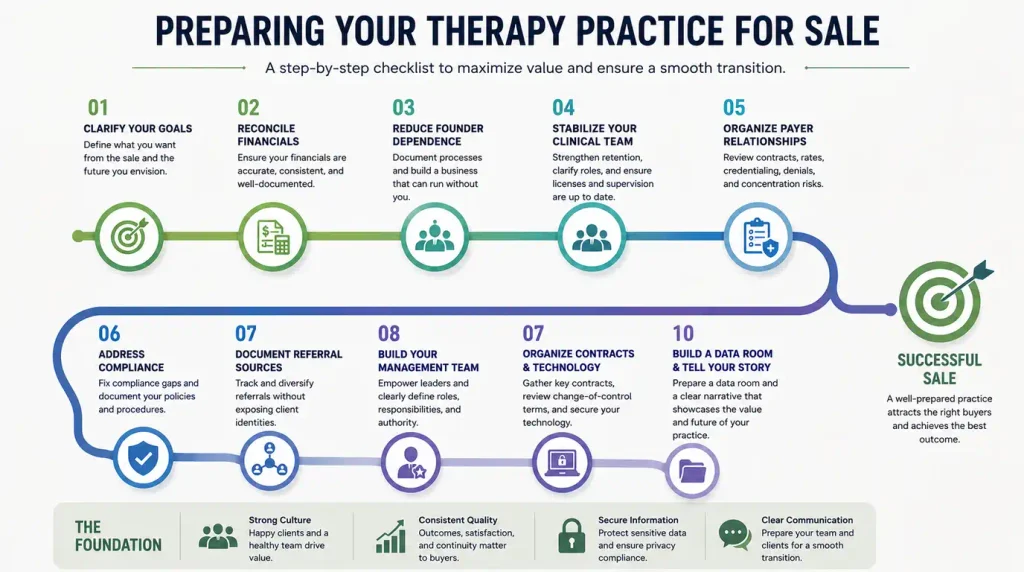
11. Organize contracts and identify consent risk
Index every material agreement and flag:
· term and renewal date;
· termination rights;
· assignment restrictions;
· change-of-control provisions;
· notice or consent requirements;
· pricing and escalation;
· exclusivity;
· data ownership and return;
· indemnity and limitation of liability;
· noncompete, nonsolicitation and confidentiality terms.
Include payer contracts, clinician and employee agreements, leases, loans, software and EHR agreements, billing vendors, referral arrangements, marketing vendors, equipment, insurance, and any ownership or buy-sell agreement.
12. Prepare technology and cybersecurity evidence
List systems, owners, vendors, renewal dates, integrations, users, data flows, backups, incidents, and planned investments. Buyers will need to understand whether systems can transfer, remain in place, or migrate without disrupting care or billing.
Behavioral-health diligence treats EHR functionality, outcomes reporting, interoperability, privacy and security as operating and transaction issues, not merely IT details.
13. Measure clinical quality without turning culture into marketing copy
Document how the practice handles supervision, complaints, adverse events, continuity, caseloads, quality review, and outcomes where appropriate. Use measures the practice actually collects and understands. Do not manufacture success rates for a sale process.
A buyer will compare the written model with clinician interviews, workflow, chart samples where lawfully reviewed, and operating data. The evidence should show how quality is maintained after the founder steps back.
14. Model transaction structure and net proceeds
Enterprise value is not the same as cash at closing or net proceeds. Model:
· cash at close;
· debt repayment and excess cash;
· working-capital target and true-up;
· escrow and holdback;
· earnout;
· seller financing;
· rollover equity;
· transaction fees;
· taxes;
· post-closing compensation and obligations.
If the deal is structured as an applicable asset acquisition, buyer and seller may have to allocate purchase consideration among asset classes and report it on Form 8594. The IRS explains that allocation determines the buyer’s basis and the seller’s gain or loss by asset. Tax modeling should happen before the allocation is negotiated.
15. Build the data room before launch
A data room is not a dumping ground. It should be indexed, access-controlled, current, and reviewed for privacy and privilege. Consistent file names and a request tracker reduce confusion during diligence.
Building the room early also exposes missing signatures, inconsistent reports, lapsed credentials, and unsupported adjustments while the seller still has leverage to address them. End-to-end behavioral-health sale guidance treats financial, payer, clinician, compliance, site, technology and operating evidence as one connected fact base.
Therapy-practice sale data-room checklist
Corporate and ownership
· formation documents, amendments and good-standing records;
· ownership ledger, operating agreement, bylaws and buy-sell agreements;
· minutes, consents and material governance records;
· related entities and intercompany agreements.
Financial and tax
· historical and trailing financial statements;
· tax returns and general-ledger detail;
· bank, debt, lease and capital-expenditure schedules;
· accounts receivable, collections, refunds and write-offs;
· normalized earnings and add-back support;
· revenue by payer, service line, location and clinician where appropriate.
Workforce
· de-identified roster for early review;
· licenses, credentials, supervision and training records;
· employment and contractor agreements;
· compensation, benefits, bonuses and accrued obligations;
· turnover, recruiting and open-position data;
· handbooks, policies and claims.
Payers, billing and compliance
· payer contracts, rates, amendments and correspondence;
· enrollment and clinician credentialing matrix;
· authorization, denial, appeal and recoupment reports;
· billing policies, audits and remediation;
· licenses, certifications and exclusion-screening records;
· privacy, security, telehealth and incident documentation.
Operations, clinical quality and commercial
· organization chart and responsibility matrix;
· policies for intake, scheduling, supervision and continuity;
· aggregated caseload, utilization and no-show reporting;
· quality and outcome measures actually used by the practice;
· aggregated referral-source and marketing data;
· service-line, location and capacity information.
Contracts, facilities and technology
· leases, vendor contracts and insurance policies;
· EHR, billing, telehealth and cybersecurity agreements;
· system inventory, data flows, access controls and backup plan;
· intellectual property, domains, trademarks and content rights;
· litigation, complaints, investigations and settlement records.
Privacy rules for the sale-preparation process
Early buyer analysis rarely needs identifiable client information. Use totals, ranges, cohorts or de-identified data where they answer the question. Give each advisor or buyer only the access needed for the current stage.
HHS includes sale or transfer of assets within healthcare operations but still requires reasonable efforts to limit many uses and disclosures to the minimum necessary. Psychotherapy notes are specially protected and generally require authorization outside narrow exceptions. State law and professional obligations may be more restrictive.
A safe process should include a privacy review, nondisclosure terms, business associate analysis, role-based access, audit logs, download restrictions where appropriate, and a plan for return or destruction if a buyer exits the process.
A phased preparation plan
Phase 1: Diagnose
· Define owner goals and likely transaction paths.
· Estimate normalized SDE or EBITDA.
· Map founder responsibilities, clinicians, payers, referrals and contracts.
· Run legal, privacy, billing, credentialing and tax issue-spotting reviews.
· Prioritize issues by value impact, closing risk, effort and time to demonstrate improvement.
Phase 2: Correct and document
· Reconcile financial and operating reports.
· Fix supported compliance and credentialing gaps.
· Delegate founder responsibilities and test management.
· Strengthen retention, recruiting and supervision.
· Renew or clarify important contracts where appropriate.
· Create policies that match actual practice.
Phase 3: Prepare for market
· Finalize valuation analysis and net-proceeds scenarios.
· Build the indexed, privacy-reviewed data room.
· Prepare the teaser, confidential memorandum and management presentation.
· Qualify buyers and define information-release stages.
· Set rules for LOI comparison, exclusivity and diligence.
· Prepare clinician, staff, client, payer and referral communication plans.
Phase 4: Maintain readiness
· Update trailing results and forecasts.
· Keep licenses, credentialing and contracts current.
· Track retention, referrals, collections, denials and quality.
· Record incidents and remediation promptly.
· Continue operating as if diligence could begin tomorrow.
Warning signs to address before approaching buyers
· Tax returns, financial statements and billing reports do not reconcile.
· The founder cannot take a week away without routine decisions stopping.
· A small number of clinicians produce most of the practice’s revenue.
· Credentialing status is kept in email rather than a controlled roster.
· One payer or referral source dominates without a mitigation plan.
· Shared EHR accounts or former employees still have access.
· Psychotherapy notes are not separated or access-controlled.
· Material contracts are unsigned, expired or missing.
· Add-backs rely on explanation rather than evidence.
· Known refunds, overpayments, complaints or incidents have no documented resolution.
· Growth forecasts require clinicians who have not been recruited.
· The proposed asking price is based on another practice’s headline sale.
Frequently asked questions
How early should I prepare my therapy practice for sale?
Begin before a sale becomes urgent. Financial cleanup, leadership development, retention, contracting and compliance improvements are more credible when they have a track record. Even if timing is uncertain, the work can improve the practice.
Do I need a quality-of-earnings report before selling?
Not every practice needs a sell-side QoE. It may be useful for larger or more complex transactions, especially when adjustments, revenue recognition, payer concentration or rapid growth require independent analysis. Discuss the cost and likely benefit with your advisor and accountant.
What financial records will a buyer request?
Expect financial statements, tax returns, general-ledger detail, payroll, billing and collections, accounts receivable, debt, leases, owner compensation, and support for adjustments. The exact period and detail depend on the buyer, financing and transaction size.
Should I reduce my clinical caseload before selling?
Reducing founder dependence can help, but do it carefully. A sudden reduction without replacement capacity may lower revenue. Build clinician and leadership coverage, transfer responsibilities, and demonstrate stable performance.
Can I share client information with a buyer?
Do not assume you can. Use aggregated or de-identified information where possible. HIPAA, state law, professional duties, record type, transaction structure and the purpose of disclosure all matter. Psychotherapy notes receive special protection. Obtain privacy counsel before sharing PHI.
What is the biggest cause of a price reduction during diligence?
There is no single cause, but reductions often follow a mismatch between the marketed story and verified facts, such as unsupported earnings, concentration, clinician instability, payer exposure or compliance issues. Early self-diligence reduces surprise risk.
Prepare the evidence before you need the buyer
A sale-ready practice can explain where its earnings come from, who will sustain them, what could interrupt them, and how client care will continue. Therapy Practice Exit Report helps owners understand the readiness work before a buyer sets the timetable. Olympic M&A supports healthcare and founder-led business owners with sale preparation, positioning, and transaction execution.
Visit Olympic M&A for a confidential conversation about sale readiness.