

Quick answer:
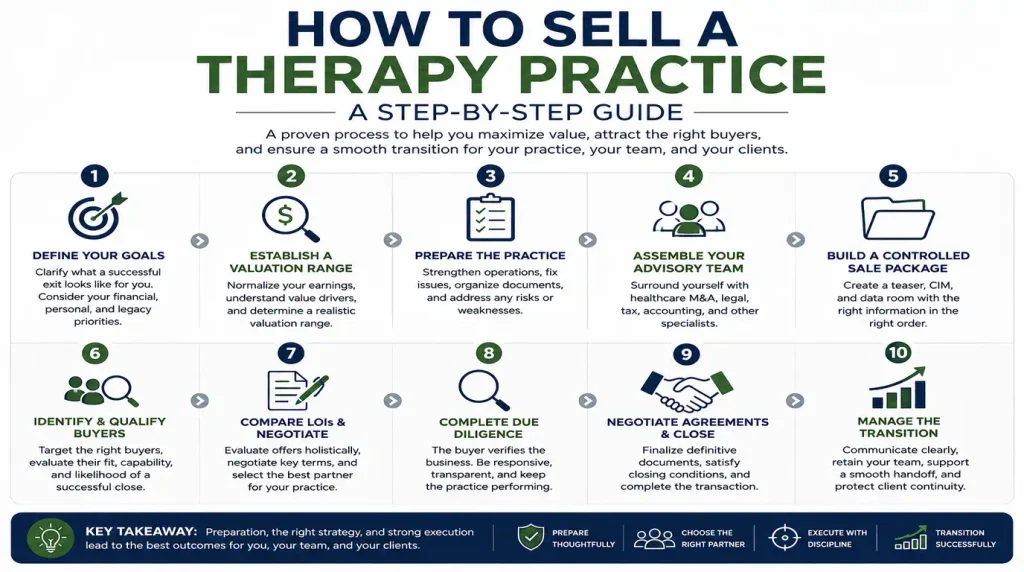
To sell a therapy practice, define what you want from the transaction, establish a defensible valuation range, prepare the financial and operating evidence, approach qualified buyers confidentially, compare complete offers, negotiate a letter of intent, complete healthcare-specific due diligence, sign definitive agreements, close, and manage the transition without disrupting clinicians or care.
The work is sequential, but it is not mechanical. A buyer is testing whether the practice’s earnings, clinicians, payer relationships, referrals, systems, and clinical culture will survive a change in ownership. The strongest sale process answers those questions before the buyer controls the timeline.
How to sell a therapy practice in 10 steps
1. Decide what a successful exit means to you
Price matters, but it is not the only decision. Before speaking with buyers, write down your priorities:
· full sale, majority recapitalization, minority investment, or internal succession;
· cash at closing versus future or contingent value;
· the length and nature of your post-closing role;
· protection for clinicians, leadership, clients, and clinical culture;
· brand continuity and community presence;
· your preferred timing and willingness to delay;
· risk you are prepared to retain through an earnout, seller note, escrow, or rollover equity.
A buyer’s highest headline number may conflict with your transition, employment, governance, or culture priorities. Define the tradeoffs before an offer makes them feel abstract.
2. Establish a valuation range
A therapy practice is generally valued on normalized seller’s discretionary earnings or adjusted EBITDA, depending on size and owner involvement. The multiple then reflects earnings quality, transferability, growth, risk, and buyer demand.
Do not begin by selecting a multiple. Reconcile the earnings base first. Document owner compensation, personal expenses, one-time costs, related-party transactions, and the market-rate cost of replacing work you perform.
For the full framework, read How Much Is My Therapy Practice Worth? and What Multiple Do Therapy Practices Sell For?
3. Prepare the practice before approaching buyers
Buyers will examine more than financial statements. Behavioral-health diligence commonly covers payer mix, revenue-cycle performance, licensing, privacy, telehealth, clinician credentials, turnover, outcomes, referrals, EHR systems, cybersecurity, leases, and historical investigations or disputes.
Correct what can be corrected. Quantify what cannot. A known issue with a documented remediation plan is easier to underwrite than a surprise discovered after exclusivity.
Use the companion checklist: How to Prepare a Therapy Practice for Sale.
4. Assemble the right advisory team
The team depends on the transaction, but it often includes:
· a healthcare M&A advisor or business broker appropriate to the practice’s size;
· healthcare transaction counsel;
· a tax advisor who understands asset and equity transactions;
· an accountant or quality-of-earnings provider;
· privacy, billing, credentialing, or regulatory specialists where needed;
· a personal financial advisor for post-sale planning.
Choose advisors before a buyer’s draft documents set the frame. A generalist may understand business sales yet miss therapy-specific issues around credentialing, record handling, clinical supervision, licensure, payer assignment, and continuity of care.
5. Build a controlled sale package
A professional process usually moves from less sensitive to more sensitive information:
1. Anonymized teaser: enough information to test buyer interest without naming the practice.
2. Nondisclosure agreement: signed before identifiable or detailed information is released.
3. Confidential information memorandum: history, services, market, team, financial performance, growth, and risks.
4. Management presentation: a structured discussion of the practice and buyer’s plan.
5. Data room: controlled access to detailed financial, legal, payer, workforce, compliance, and operating records.
Behavioral-health sale guidance recommends staging access to sensitive patient, clinician, compensation, referral, claims, and payer information according to buyer seriousness and the purpose of the request.
6. Identify and qualify buyers
A long buyer list is not the same as a qualified buyer group. Evaluate each party’s:
· reason for acquiring the practice;
· experience with outpatient therapy and behavioral health;
· available capital and financing plan;
· reputation with founders and clinicians;
· integration approach and decision authority;
· geographic, payer, and service-line fit;
· history of closing transactions similar to yours.
Confidential outreach can create alternatives without broadcasting the sale. Avoid sharing identifiable staff or client information simply to satisfy an early inquiry.
7. Compare indications of interest and letters of intent
An indication of interest is usually a preliminary proposal. A letter of intent, or LOI, sets the commercial framework for the buyer’s exclusive diligence and definitive-document process. Most LOI provisions are described as nonbinding, but confidentiality, exclusivity, access, expenses, and governing-law provisions may be binding. Counsel should review the document before signature.
Compare the whole transaction, not only enterprise value. A disciplined LOI review examines cash at close, working capital, debt and cash treatment, rollover equity, earnout, seller financing, escrow, employment terms, restrictive covenants, financing conditions, diligence scope, exclusivity, and closing conditions.
8. Complete due diligence while protecting performance
Due diligence usually intensifies after the LOI. The buyer verifies the business it underwrote and looks for liabilities not apparent in the marketing materials. Healthcare diligence typically runs several tracks at once: financial, legal, regulatory, operational, clinical, and workforce.
The quality-of-earnings review, or QoE, is often central. The buyer’s accounting team tests reported earnings and every material adjustment. If the accepted earnings base falls, the proposed value may fall with it.
Keep operating the practice. A missed budget, avoidable clinician departure, lapsed credential, or deteriorating collection cycle during diligence can change the buyer’s view of value.
9. Negotiate definitive agreements and closing mechanics
The purchase agreement converts the LOI into enforceable terms. Depending on the structure, it may address:
· assets or equity being transferred;
· purchase price and adjustment mechanics;
· representations and warranties;
· indemnification, baskets, caps, escrows, and survival periods;
· working capital and debt-like items;
· payer, lease, vendor, and contract consents;
· clinician and management retention conditions;
· employment, consulting, earnout, rollover, and restrictive-covenant terms;
· privacy, records, credentialing, and continuity obligations;
· conditions that must be satisfied before closing.
If the transaction is an applicable asset acquisition, buyer and seller may need to allocate consideration among asset classes and report the allocation on IRS Form 8594. The allocation affects the buyer’s basis and the seller’s gain or loss by asset, so both sides should involve tax advisors before the allocation is fixed.
Restrictive covenants require current, state-specific legal analysis. The FTC states that its 2024 federal Noncompete Rule is not in effect and is not enforceable; that does not answer whether a particular covenant is valid under state law or professional rules.
10. Close and manage the transition
Closing transfers ownership or agreed assets after the conditions are satisfied. Operational transition may continue well beyond that date.
A therapy-practice transition plan should address:
· who is informed, by whom, and in what order;
· clinical and administrative leadership after closing;
· clinician retention and employment changes;
· payer enrollment, billing, credentialing, and authorizations;
· leases, vendors, EHR access, cybersecurity, and data migration;
· client communication, continuity of care, records, and privacy;
· brand, referral relationships, and community communication;
· the seller’s authority, schedule, compensation, and handoff duties.
Do not treat clinical culture as a slogan in the announcement. Show how supervision, caseload expectations, compensation, documentation, and decision-making will work after the change.
Who buys therapy practices?
| Buyer type | What may attract them | Questions for the seller |
| Individual clinician or local operator | Established practice, cash flow, team and local reputation | Can they finance the purchase and replace the owner’s role? |
| Regional therapy or behavioral-health group | Geographic density, clinicians, payer access and referrals | How will they integrate operations and protect the team? |
| Private-equity-backed platform | Adjusted EBITDA, add-on fit, scalable systems and growth | What are the rollover, governance, leverage and future-exit terms? |
| Strategic healthcare organization | New services, market entry, care coordination or payer relationships | Which synergies are real, and what happens to clinical autonomy? |
| Internal successor or management team | Continuity, existing knowledge and cultural fit | How will the transaction be financed and governance transferred? |
The same practice can be worth different amounts to different buyers. Fit affects price, structure, diligence, transition, and probability of closing.
How to compare therapy-practice LOIs
| Term | What to clarify | Why it matters |
| Enterprise value | Earnings base, multiple and assumed liabilities | The headline may rest on adjustments the buyer has not verified |
| Cash at close | Exact amount and funding conditions | It is the least contingent part of the consideration |
| Working capital | Definition, target and true-up method | Affects final proceeds after the headline price |
| Earnout | Metric, control, period, accounting rules and remedies | Future payment may depend on factors outside the seller’s control |
| Rollover equity | Entity, class, rights, dilution, leverage and exit path | Quoted value is not the same as liquid cash |
| Seller note | Interest, payment terms, security and subordination | The seller becomes a creditor of the buyer |
| Employment | Role, authority, pay, term and termination | The post-closing job can change the practical value of the deal |
| Exclusivity | Length, extensions, milestones and termination rights | The seller gives up alternatives while the buyer investigates |
What buyers review during therapy-practice due diligence
· Financial: monthly statements, tax returns, bank records, payroll, add-backs, accounts receivable, collections, debt, and working capital.
· Payer and revenue cycle: contracts, credentialing, enrollment, rates, denials, refunds, recoupments, authorizations, and concentration.
· Workforce: roster, licenses, compensation, classification, tenure, turnover, supervision, productivity, and agreements.
· Legal: formation, ownership, minutes, material contracts, leases, disputes, insurance, and intellectual property.
· Compliance: privacy and security, billing, telehealth, licensure, exclusions, audits, complaints, and remediation.
· Clinical operations: service lines, scheduling, caseloads, no-shows, quality processes, supervision, and continuity planning.
· Technology: EHR, billing, access controls, backups, cybersecurity, vendor contracts, and migration requirements.
· Commercial: referral channels, brand, marketing economics, market position, and growth assumptions.
Behavioral-health diligence connects these areas. A credentialing gap can affect collections. Turnover can affect capacity. Weak documentation can create billing risk. Poor access controls can create privacy and transaction risk.
How to protect client and practice information during a sale
Do not place identifiable client records into a general buyer data room. Start with aggregated or de-identified information when it can answer the business question. Limit access by role, stage information, keep audit logs, and involve privacy counsel before disclosing protected health information.
HHS treats sale or transfer of assets as a type of healthcare operation in its HIPAA guidance, subject to applicable limits and safeguards. It also requires covered entities to make reasonable efforts to limit many healthcare-operations disclosures to the minimum necessary.
Advisors or vendors that create, receive, maintain, or transmit protected health information on behalf of a covered entity may be business associates, requiring an appropriate written agreement and safeguards before access.
Psychotherapy notes receive special protection and generally require individual authorization for uses or disclosures beyond narrow exceptions. State confidentiality law, professional duties, payer rules, and 42 CFR Part 2 may impose additional requirements. Counsel should design the disclosure and records-transfer process for the specific practice.
How long does it take to sell a therapy practice?
There is no standard timeline. Preparation, buyer outreach, financing, payer and lease consents, credentialing, diligence, documentation, and regulatory requirements all affect duration.
As one current healthcare M&A source describes it, post-LOI diligence often runs about 60 to 90 days, with larger or more complex businesses taking longer. That period is only one phase. Preparation and buyer selection happen before it; consents, definitive documents, financing, and closing conditions may extend the process.
If a buyer plans to use SBA-backed financing, confirm current requirements directly with the buyer’s lender. SBA’s SOP 50 10 is the controlling policy source for its 7(a) and 504 programs and is updated over time.
Common mistakes when selling a therapy practice
· Taking the first unsolicited offer without understanding value or alternatives.
· Applying a large-platform multiple to a founder-dependent practice.
· Signing an LOI before legal and tax review.
· Granting long exclusivity without milestones or a credible diligence plan.
· Using unsupported add-backs or failing to price owner replacement.
· Ignoring payer assignment, enrollment, or credentialing until late in the process.
· Sharing client or clinician information too early or too broadly.
· Assuming clinician restrictive covenants will solve retention risk.
· Allowing performance to slip during diligence.
· Comparing offers on enterprise value without modeling cash, debt, working capital, escrow, earnout, rollover, fees, and taxes.
· Announcing the sale without a continuity and communication plan.
Frequently asked questions
Can I sell a therapy practice if I am the main clinician?
Possibly, but the buyer will assess how much revenue and goodwill depend on your personal work and relationships. A transition period, documented systems, transferable referral channels, and a plan to replace your clinical and management responsibilities may be necessary.
Should I tell employees that the practice is for sale?
There is no universal answer. Early disclosure can create avoidable anxiety, while late disclosure can damage trust or retention. Plan the timing with counsel and advisors, identify who must know for diligence, and prepare a clear continuity message.
Is an LOI the final purchase agreement?
No. The LOI usually summarizes the proposed economics and process. The definitive purchase agreement follows diligence and contains the enforceable transaction terms. Some LOI provisions may still be binding, so obtain legal review before signing.
What is a quality-of-earnings review?
A QoE is a detailed financial review that tests whether reported earnings are accurate, sustainable, and supported. It examines revenue, expenses, timing, accounting policies, concentration, and add-backs that affect valuation.
Can client records transfer with the practice?
Record transfer depends on transaction structure, HIPAA, state law, professional requirements, contract terms, and the type of record. Psychotherapy notes receive special protection. Use healthcare privacy counsel rather than assuming the entire EHR can be handed to a buyer.
Is an asset sale or equity sale better?
Neither is always better. The forms allocate assets, liabilities, contracts, tax consequences, consents, and historical risk differently. Buyer and seller often prefer different structures. Healthcare transaction counsel and tax advisors should model both.
Enter the market with the facts organized
A therapy-practice sale is easier to negotiate when your value, risks, priorities, and transition requirements are clear before exclusivity begins. Therapy Practice Exit Report helps owners learn the process before they enter the market. Olympic M&A advises healthcare and founder-led business owners through preparation, positioning, buyer discussions, and transaction execution.
Visit Olympic M&A for a confidential conversation about selling your practice.