

Quick answer:
What multiple do therapy practices sell for? Published counseling-center data show roughly 1.94× to 3.14× seller’s discretionary earnings (SDE) for smaller owner-operated practices and 3.37× to 5.40× EBITDA for larger counseling centers. Scaled institutional mental-health platforms and add-ons may trade at higher EBITDA multiples, but those benchmarks do not apply automatically to a local group practice.
The right multiple depends on what is being multiplied, the quality and durability of the earnings, how dependent the practice is on its founder, and which buyers can complete the transaction. A 3× SDE offer and a 5× EBITDA offer cannot be compared until both the earnings base and the deal terms are reconciled.
What multiple do therapy practices sell for in the current market?
There is no single therapy-practice multiple. The following published ranges provide a starting point:
| Practice or transaction profile | Common metric | Published range | Source and scope |
| Smaller counseling center or owner-operated practice | SDE | 1.94×–3.14× | Peak Business Valuation counseling-center transaction data[2] |
| Established counseling center | EBITDA | 3.37×–5.40× | Peak Business Valuation counseling-center transaction data[2] |
| Counseling center, high-level cross-check | Revenue | 0.40×–0.69× | Peak Business Valuation; not a substitute for profit analysis[2] |
| Mental-health/outpatient psychiatry add-on | EBITDA | 4×–8× | FOCUS 2025 U.S. institutional benchmark[4] |
| Scaled mental-health/outpatient psychiatry platform | EBITDA | 10×–14× | FOCUS 2025 U.S. institutional benchmark[4] |
These categories describe different businesses and buyer pools. The Peak ranges are closer to the market for many independent counseling businesses. The FOCUS ranges describe institutional behavioral-health transactions in which scale, management, accreditation, multi-state operations, and sophisticated buyer demand can materially change pricing.
The reported ranges also use different datasets, dates, definitions, and transaction sizes. They should not be blended into one “average” multiple. For a complete valuation framework, read How Much Is My Therapy Practice Worth?
Why can two therapy practices receive very different multiples?
A multiple is a compact expression of risk and expected growth. A buyer may pay more for each dollar of earnings when those earnings appear stable, transferable, well documented, and capable of growing. The buyer may pay less when the earnings depend on one owner, a few clinicians, a concentrated payer, or informal systems.
Business size also changes the buyer pool. The IBBA’s Q3 2025 Market Pulse reported median multiples across all industries of 2× SDE below $500,000 in business value, 2.5× SDE from $500,000 to $1 million, 3× SDE from $1 million to $2 million, 4× EBITDA from $2 million to $5 million, and 6.5× EBITDA from $5 million to $50 million.
Those are not therapy-specific multiples. They show a broader market pattern: larger companies often command higher multiples because they can attract more professional buyers, support management infrastructure, and offer more diversified earnings. Size by itself is not enough. A larger practice with weak margins, unstable clinicians, or unresolved compliance issues can still trade at a discount.
How an SDE multiple works
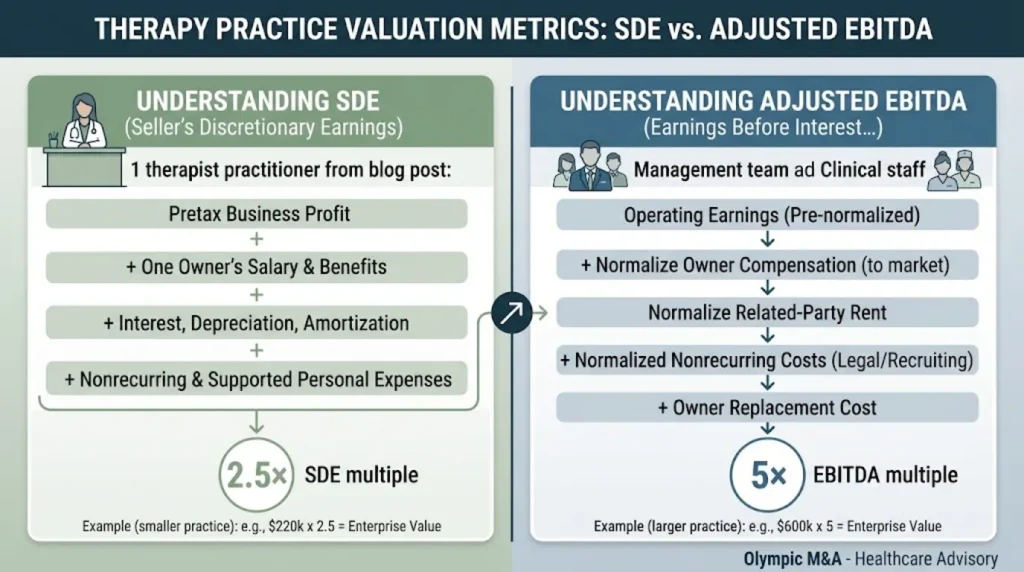
SDE is commonly used for a practice where one working owner receives both compensation and profit. A simplified SDE calculation may include:
- Pretax business profit;
- One owner’s salary and benefits;
- Interest, depreciation, and amortization;
- Documented personal expenses run through the business;
- Genuinely nonrecurring expenses.
Every add-back needs support. Calling an ordinary, recurring expense “one-time” does not make it disappear for a buyer. If the buyer must hire someone to replace work performed by the owner, that replacement cost also affects the economics.
SDE multiple example
Assume a smaller group practice produces $220,000 in defensible SDE. At an illustrative 2.5× SDE multiple:
$220,000 × 2.5 = $550,000 estimated enterprise value.
This figure assumes the SDE and multiple have been calculated consistently. Debt, cash, working capital, taxes, fees, and deal structure still need separate analysis.
How an EBITDA multiple works
EBITDA is generally more useful when the practice operates through a clinical and administrative team rather than one owner-operator. Adjusted EBITDA begins with operating earnings and normalizes items such as:
· Interest, taxes, depreciation, and amortization;
· Owner compensation above or below market;
· Related-party rent that differs from market rent;
· Documented nonrecurring legal, recruiting, relocation, or technology costs;
· Personal expenses that will not continue;
· The cost of replacing responsibilities that the owner currently performs without market-rate compensation.
The IRS business valuation guidelines call for the benefit stream and multiple to be consistent and for risk, industry, earnings stability, marketability, and control to be considered in the conclusion.
EBITDA multiple example
Assume an established group practice has $600,000 in adjusted EBITDA and supports an illustrative 5× multiple:
$600,000 × 5 = $3,000,000 estimated enterprise value.
The multiple tells only part of the story. A buyer will still examine whether the $600,000 is supported by collected revenue, clinician capacity, payer contracts, stable compensation, and a management structure that remains after closing.
Why revenue multiples can mislead
A revenue multiple is easy to calculate, which makes it tempting. It is also blunt.
Consider two therapy groups with $2 million in annual revenue. One has strong collections, stable clinicians, and a 20% adjusted EBITDA margin. The other has rising denials, high turnover, and a 5% margin. A revenue multiple treats the top line as if those businesses were economically similar. They are not.
Revenue can still be useful as a cross-check, particularly when comparable transaction data use revenue. It should be reconciled with normalized earnings, margins, and the assets and risks that produce the revenue. Therapy-practice valuation guidance likewise describes revenue methods as less accurate than earnings-based methods because they do not capture operating expenses.
What is the difference between a platform and an add-on?
Platform practice
A platform is a business a buyer can use as a base for future growth or acquisitions. It usually has a management team, financial reporting, recruiting and credentialing functions, revenue-cycle infrastructure, clinical governance, and enough scale to support those functions.
Add-on practice
An add-on, sometimes called a tuck-in, is acquired by an existing platform or larger operator. The buyer may expect to integrate billing, technology, management, payer contracting, or other functions. Add-ons can be attractive, but the buyer may also price integration work and concentration risk into the offer.
FOCUS reports higher ranges for scaled mental-health platforms than for add-ons and identifies clinical workforce stability, centralized operating infrastructure, accreditation, and market density as important value drivers.
Seven factors that move a therapy practice’s multiple
1. Owner independence
A practice is easier to transfer when the founder is not the only source of referrals, supervision, clinical production, recruiting, and operating decisions. Buyers may discount a founder-dependent practice or tie part of the price to a transition or earnout.
2. Clinician retention
Clinical revenue follows clinicians. Buyers will test tenure, turnover, compensation, supervision, caseload, productivity, open roles, employment or contractor arrangements, and the likelihood that key people will remain.
HRSA projects substantial shortages across behavioral-health occupations and identifies burnout and reimbursement pressure among the constraints on retention. A credible recruiting and retention system can therefore affect both forecast risk and the multiple.
3. Payer mix and reimbursement quality
Buyers consider reimbursement rates, concentration, denials, days in accounts receivable, credentialing, authorization requirements, write-offs, and the durability of contracts. The best payer mix is the one the practice can document and operate profitably without excessive concentration.
4. Earnings quality
Consistent financials, reconciled tax returns, a clean general ledger, and supported add-backs help a buyer trust the earnings base. Aggressive adjustments tend to create more diligence, not more value.
5. Referral durability
Practice-owned referral channels are generally easier to transfer than relationships tied entirely to the founder. Buyers will look for referral diversity, conversion, demand by service line, and evidence that marketing spend produces collected revenue.
6. Management and systems
A real operating layer can support a higher multiple when it reduces disruption after closing. Useful evidence includes clear roles, documented workflows, reliable reporting, leadership below the owner, and functioning systems for intake, scheduling, billing, credentialing, supervision, privacy, and compliance.
7. Scale and growth that can be executed
Scale can attract more buyers, but only if the organization can support it. A backlog of demand is not worth much without clinician capacity. A new state is not a growth engine until licensure, payer access, management, and compliance are addressed.
What lowers a therapy-practice multiple?
· The founder carries a large share of revenue or referrals;
· Key clinicians are likely to leave;
· One payer or referral source dominates revenue;
· Financial statements do not reconcile with tax, payroll, or billing records;
· Add-backs are unsupported or recurring;
· Credentialing, licensing, classification, privacy, or billing issues remain unresolved;
· Margins are falling without a documented explanation;
· Management exists in title but not in day-to-day authority;
· Growth forecasts require unfilled roles, unsigned contracts, or unproven locations;
· The asking price is based on a platform multiple for a business that is not a platform.
How can an owner improve the multiple?
The practical goal is to reduce buyer uncertainty without damaging the clinical culture that created the business.
1. Move knowledge out of the founder’s head. Document responsibilities and give qualified leaders real authority.
2. Track clinician retention. Measure turnover, tenure, hiring time, caseload, and reasons people leave.
3. Reconcile financial and operating data. Make revenue, collections, payroll, production, and the general ledger tell the same story.
4. Clean the add-back schedule. Keep only adjustments that are specific, documented, and unlikely to recur.
5. Measure payer and referral concentration. Address preventable reliance before going to market.
6. Resolve known compliance issues. Do not wait for a buyer’s diligence team to find them.
7. Demonstrate change over time. One month of improved margin or reduced owner caseload is less persuasive than a sustained record.
These steps may improve earnings, the multiple, certainty of closing, or all three. None guarantees a particular price.
How to compare two offers with different multiples
First, put both offers on the same basis:
8. Confirm whether each buyer is multiplying SDE or adjusted EBITDA.
9. Compare every normalization adjustment.
10. Confirm whether the quoted result is enterprise value or equity value.
11. Reconcile debt, cash, and working capital.
12. Separate cash at closing from seller notes, earnouts, escrow, and rollover equity.
13. Model the probability and timing of contingent payments.
14. Compare the owner’s post-closing role, compensation, restrictions, and transition obligations.
15. Estimate transaction fees and taxes with qualified advisors.
A lower multiple with cleaner adjustments and more cash at closing can be worth more than a higher headline multiple supported by aggressive EBITDA, a difficult earnout, or uncertain rollover equity. Price, structure, and certainty to close belong in the same analysis.
Questions to ask when someone quotes a multiple
· What exactly is the earnings metric?
· Which period is being used: last fiscal year, trailing 12 months, or forecast?
· Which add-backs and deductions are included?
· What comparable transactions support the range?
· Are the comparables therapy practices, broader behavioral-health businesses, or all industries?
· What were the transaction sizes and dates?
· Is the quoted number enterprise value or expected equity proceeds?
· How much is cash at closing?
· What conditions apply to earnout or rollover value?
· What owner transition and clinician-retention assumptions are built in?
Frequently asked questions
Do therapy practices sell for a multiple of revenue or profit?
Most credible valuations place more weight on normalized earnings, using SDE for smaller owner-operated practices or adjusted EBITDA for larger groups. Revenue multiples can provide a cross-check, but they do not show profit or staffing cost.
What is a good EBITDA multiple for a therapy practice?
A “good” multiple depends on size, earnings quality, owner independence, clinician stability, payer mix, growth, and buyer type. Published counseling-center benchmarks of 3.37× to 5.40× EBITDA may help orient an independent group practice, while institutional add-ons and platforms can trade outside that range.
Can a small therapy practice receive an EBITDA multiple?
It can, but SDE may describe the economics better when one owner performs significant clinical and management work. Buyers and advisors should use the benefit stream that matches how the practice operates.
Why are private-equity multiples higher?
Institutional buyers may pay more for scaled businesses with management, infrastructure, diversified earnings, and a clear acquisition or growth plan. Those buyers also expect more rigorous reporting and diligence. Institutional benchmarks should not be applied to a smaller founder-dependent practice without adjustment.
Does a higher multiple guarantee higher proceeds?
No. The earnings calculation, debt, cash, working capital, taxes, fees, escrow, earnout, rollover equity, and other terms all affect what the owner receives and when.
How often should I update my valuation range?
Update it when trailing earnings, owner involvement, clinician retention, payer contracts, capital markets, or buyer demand change materially. An annual planning range can be useful, with a fresh analysis before a transaction.
A multiple is the start of the conversation
A defensible therapy-practice valuation connects the multiple to the right earnings measure, comparable transactions, operating risk, and deal structure. Therapy Practice Exit Report helps owners understand the market before they act. If you have received an unsolicited offer or want to understand your likely range before approaching buyers, Olympic M&A provides M&A advisory support for healthcare and founder-led businesses.
Visit Olympic M&A to discuss valuation and market fit confidentially.