

Quick answer:
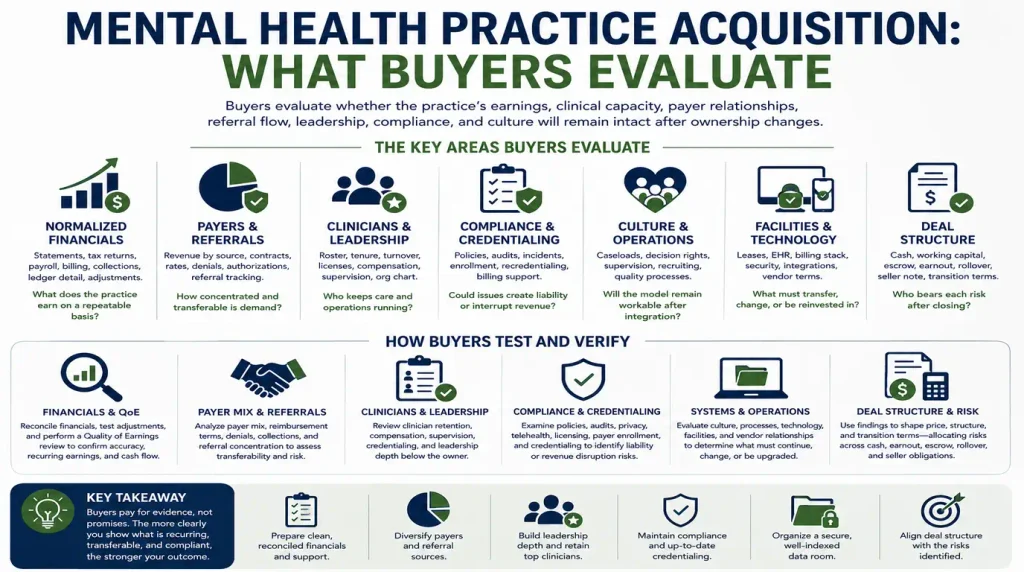
In a mental health practice acquisition, buyers evaluate whether the practice’s earnings, clinical capacity, payer relationships, referral flow, leadership, compliance, and culture will remain intact after ownership changes. They test the numbers through financial diligence and a quality-of-earnings review, then compare those numbers with contracts, credentialing files, clinician data, operating systems, and the owner’s actual role.
For a seller, the practical lesson is simple: a persuasive story is useful, but a buyer pays and structures the deal around evidence. The more clearly the practice can show what is recurring, transferable, compliant, and not dependent on one person, the easier it is for a buyer to underwrite the acquisition without filling gaps with conservative assumptions.
What do buyers evaluate in a mental health practice acquisition?
Buyers are trying to answer two connected questions: “What does this practice earn?” and “How much of that earning power will remain after closing?” The second question reaches far beyond accounting. It includes the clinicians delivering care, payer and referral concentration, management depth, regulatory exposure, systems, facilities, and the terms needed to transfer the business.
| Area | Evidence buyers test | Underlying question |
| Normalized financials | Statements, tax returns, payroll, billing, collections, ledger detail, adjustments | What does the practice earn on a repeatable basis? |
| Payers and referrals | Revenue by source, contracts, rates, denials, authorizations, referral tracking | How concentrated and transferable is demand? |
| Clinicians and leadership | Roster, tenure, turnover, licenses, compensation, supervision, organization chart | Who keeps care and operations running? |
| Compliance and credentialing | Policies, audits, incidents, enrollment, recredentialing, billing support | Could historical practices create liability or interrupt revenue? |
| Culture and operations | Caseloads, decision rights, supervision, recruiting, quality processes | Will the model remain workable after integration? |
| Facilities and technology | Leases, EHR, billing stack, security, integrations, vendor terms | What must transfer, change, or be reinvested in? |
| Deal structure | Cash, working capital, escrow, earnout, rollover, seller note, transition terms | Who bears each identified risk after closing? |
Behavioral-health M&A guidance from VERTESS, an industry transaction adviser, likewise describes diligence across financial performance, regulatory matters, privacy, telehealth, investigations, technology, data systems, and security. It is useful sector guidance, not a legal standard or a substitute for transaction-specific advice.
How do buyers test normalized financials and quality of earnings?
What are normalized financials?
Normalized financials adjust reported results to show the income and expenses a buyer reasonably expects under new ownership. The analysis may remove a documented one-time cost, correct unusual timing, normalize related-party expenses, and replace owner labor with an appropriate market-rate cost. A normalization is not valid merely because it improves earnings; it needs support and a credible explanation of why the item will not continue.
Buyers commonly reconcile monthly profit-and-loss statements and balance sheets with tax returns, bank activity, payroll, clinician production, claims, collections, accounts-receivable aging, and the general ledger. They also test whether recent growth reflects collected revenue rather than unbilled visits, aging claims, temporary staffing, or a short-lived change in expenses.
What does QoE mean?
Quality of earnings (QoE) is a detailed financial review that tests whether reported earnings are accurate, recurring, cash-generative, and supported by the underlying records. A QoE is not the same as an audit, valuation, or guarantee. Its scope varies, but it often examines revenue recognition, expense classification, working capital, concentration, unusual items, and the adjustments used to calculate normalized earnings.
The owner-replacement adjustment deserves particular attention. If the founder handles clinical work, supervision, recruiting, referrals, finance, and operations, the buyer may subtract the cost of replacing those duties. Sellers can prepare by mapping each role and its time requirement rather than treating owner compensation as an automatic add-back. For a fuller valuation framework, see How Much Is My Therapy Practice Worth?
How do payer mix and referral concentration shape a buyer’s view?
What does a buyer look for in payer mix?
Payer mix is the share of revenue or collections coming from commercial insurance, Medicare, Medicaid, employee assistance programs, institutional contracts, private pay, and other payment sources. Buyers evaluate more than the percentages. They review reimbursement rates, contract terms, authorization requirements, denial and recoupment history, collection timing, rate changes, and the credentialing behind each revenue stream.
No single mix is automatically best. A concentrated payer relationship may produce predictable volume but create exposure to a rate change, termination, or enrollment problem. A private-pay model may reduce claims administration but depend more heavily on local demand and marketing. The seller’s job is to explain the economics and the controls, not to force every practice into the same ideal.
Why does referral concentration matter?
Referral concentration measures how much new-client demand depends on one source, channel, contract, or person. Buyers will distinguish practice-owned channels—such as payer directories, search visibility, community relationships, institutional agreements, and a recognized brand—from relationships that may leave with the founder.
Useful evidence includes referral volume by category, conversion, service line, geography, capacity, and trend. Early reports should remain aggregated and avoid client identities. Under HHS guidance, covered entities must reasonably limit many payment and healthcare-operations disclosures to the minimum necessary and use role-based access to protected health information.
How do buyers assess clinician retention, leadership depth, and owner dependence?
Will the clinicians stay?
A buyer cannot preserve revenue without the clinicians who deliver care. The review usually covers tenure, turnover, open roles, recruiting time, licenses, payer status, supervision, compensation, benefits, caseloads, productivity, location, employment or contractor classification, and agreement terms.
Retention cannot be proved by a roster alone. Buyers look for the reasons clinicians stay: manageable workloads, sound supervision, fair compensation, professional development, administrative support, trust in leadership, and a credible communication plan. They may seek retention arrangements for selected people, but culture and day-to-day working conditions still matter.
Is there leadership below the owner?
Leadership depth means qualified people other than the founder hold real responsibility and authority. A clinical director, operations leader, billing manager, or credentialing lead adds confidence only when that person can make decisions, explain performance, and continue after closing.
Buyers compare the organization chart with actual behavior. If every complaint, hire, payer escalation, cash decision, referral relationship, and clinical question returns to the founder, the practice remains owner-dependent despite formal titles. A longer owner transition, contingent consideration, or a lower accepted earnings base may be used to address that risk.
Sellers can make transferability visible by documenting responsibilities, assigning successors, tracking delegated decisions, and showing stable results when the owner is absent. The companion guide, How to Prepare a Therapy Practice for Sale, provides a broader readiness checklist.
What do buyers review in compliance and credentialing?
Does the written compliance program match actual practice?
Healthcare diligence examines conduct, not only binders. Depending on the practice, buyers and counsel may review billing and coding, documentation, overpayments, audits, refunds, privacy and security, business associate agreements, licensure, supervision, telehealth, exclusion screening, complaints, investigations, and corrective actions.
Sensitive deal information should be staged. HHS explains that a business associate is a person or entity performing certain functions involving protected health information on behalf of a covered entity; the appropriate written agreement and safeguards may be required before an adviser or diligence vendor receives that information. State confidentiality rules and 42 CFR Part 2 may impose additional limits for some records and practices.
Can payer enrollment and clinician credentialing continue?
Credentialing confirms that a clinician meets a payer’s participation requirements; enrollment connects the clinician or entity to the payer’s billing system. Buyers review executed contracts, clinician status by payer, recredentialing dates, open applications, locations, tax identifiers, reassignment arrangements, and assignment or change-of-control terms.
These details can affect both closing mechanics and post-closing cash flow. CMS directs Medicare providers and suppliers to its Provider Enrollment, Chain, and Ownership System and maintains separate enrollment and revalidation resources. Commercial and state programs have their own rules. The buyer should not assume that a provider number, contract, or credential automatically transfers because the transaction closes.
What does data-room quality tell a buyer?
A data room is the controlled repository used to share transaction records. Its quality affects both speed and trust. A useful room has a clear index, consistent file names, current documents, role-based permissions, a request tracker, and a process for redaction and privacy review.
Contradictory reports, missing signatures, unexplained versions, and folders filled with irrelevant files make buyers question the control environment. A seller should disclose known gaps with an owner and remediation status rather than conceal them. Read How to Sell a Therapy Practice for the wider sequencing of confidentiality, buyer outreach, letters of intent, diligence, and closing.
How do buyers evaluate culture, real estate, and technology?
Can clinical culture be observed in operations?
Culture is not a slogan. Buyers see it in supervision, caseload expectations, documentation standards, schedule design, compensation, communication, complaint handling, clinical autonomy, turnover, and the way difficult decisions are made. They also assess whether their integration plan would preserve or disrupt the conditions clinicians value.
A seller should describe culture with evidence: retention patterns, supervision cadence, decision rights, recruiting acceptance, quality-review processes, and employee feedback that the practice actually collects. Do not invent outcomes or employee sentiment for a sale process.
What can facilities and technology add—or complicate?
Real-estate diligence covers rent, remaining term, options, guarantees, maintenance obligations, assignment, change-of-control language, space utilization, and whether the location fits future staffing and telehealth patterns. A favorable office can support continuity; an inflexible or related-party lease may require normalization or renegotiation.
Technology review includes the EHR, practice-management and billing systems, telehealth tools, cybersecurity, access controls, backups, integrations, data ownership, vendor agreements, implementation costs, and migration risk. Buyers need to know which systems can transfer and whether changing them could interrupt scheduling, documentation, claims, or collections.
How does deal structure reflect what the buyer finds?
Diligence findings often affect structure as much as price. Cash at closing transfers risk differently from an earnout, seller note, escrow, holdback, or rollover investment. Working-capital definitions determine what level of receivables and operating liabilities remains with the business. Employment and transition terms determine the founder’s obligations after closing.
In an applicable asset acquisition, buyer and seller may need to allocate consideration among asset classes and report the transaction on IRS Form 8594. The IRS states that both parties generally file the form when a group of business assets is transferred and goodwill or going-concern value attaches or could attach. Tax advisers should model the allocation before it is fixed.
Financing can add another diligence layer. SBA describes 7(a) as its primary business-loan program and explains that borrowers apply through participating lenders; documentation and eligibility depend on the circumstances. If a buyer relies on SBA-backed or other third-party financing, the seller should understand funding conditions and lender requirements rather than treating financing as assured.
Larger or overlapping acquisitions may also require antitrust analysis. The DOJ and FTC’s 2023 Merger Guidelines describe the nonbinding factors and frameworks the agencies use when reviewing mergers, with decisions based on the law and facts of each matter. Counsel should assess the specific markets, buyer holdings, and filing obligations; the guidelines do not create a simple pass-fail test for a local practice.
What should a seller have ready for buyer evaluation?
· Financial bridge: reported profit to normalized SDE or EBITDA, with support for every adjustment.
· QoE support: statements, tax returns, ledger detail, payroll, bank, billing, collections, and accounts-receivable records that reconcile.
· Payer matrix: contracts, rates, revenue, denials, recoupments, enrollment, credentialing, and consent requirements.
· Referral analysis: aggregated sources, conversion, concentration, trend, and founder dependence.
· Clinician roster: role, status, tenure, license, payer credentials, supervision, compensation, caseload, and agreement status.
· Leadership map: organization chart, decision rights, successors, and market-rate owner-replacement costs.
· Compliance record: policies, training, audits, incidents, complaints, investigations, remediation, and privacy safeguards.
· Culture evidence: supervision, workload, quality, communication, retention, and recruiting practices.
· Facilities and technology: leases, vendors, systems, security, access, backups, integrations, and transfer requirements.
· Structure model: cash, working capital, debt, escrow, earnout, rollover, seller financing, taxes, fees, and transition duties.
· Controlled data room: indexed, current, privacy-reviewed, permissioned, and tracked.
The list is not a demand for perfection. It is a way to identify which facts are strong, which issues need remediation, and which risks should be addressed directly in the transaction rather than discovered under exclusivity.
Frequently asked questions
What is the first thing a buyer reviews in a mental health practice acquisition?
Most buyers begin with financial performance and a high-level view of clinicians, payers, referrals, and owner involvement. They want to know whether the opportunity fits before committing to full diligence. Detailed QoE, legal, compliance, and operational review usually follows as the process advances.
Does a buyer always require a quality-of-earnings report?
No. Scope depends on transaction size, financing, complexity, and buyer policy. Even without a formal third-party report, buyers usually test earnings, adjustments, collections, working capital, concentration, and reconciliation to source records.
Can strong revenue offset high clinician turnover?
Not automatically. Revenue generated by clinicians who may leave is less transferable. A buyer will examine tenure, recruiting, vacancies, compensation, supervision, caseloads, and retention conditions before deciding how much of current performance is durable.
Is a concentrated payer mix always a deal breaker?
No. Concentration is a risk to understand, not an automatic rejection. Contract strength, reimbursement, renewal history, demand, credentialing, collections, and alternatives all affect the assessment. Buyers may address the risk through price, structure, closing conditions, or a mitigation plan.
How much client information should be in the data room?
Use aggregated or properly de-identified information whenever it answers the business question. Do not place identifiable client records in a general data room. HIPAA, state law, professional duties, 42 CFR Part 2 where applicable, and the purpose of disclosure require transaction-specific privacy review.
Why does owner dependence affect the offer?
If the owner produces revenue, controls referrals, supervises clinicians, and makes every operating decision, earnings may fall when the owner leaves. Buyers may account for that through owner-replacement costs, a longer transition, retention terms, contingent consideration, or a different view of value.
Is an asset purchase better than an equity purchase?
Neither is always better. The structures differ in how assets, liabilities, contracts, taxes, consents, records, and historical risks are handled. The best fit depends on the entity, payer and licensing rules, tax consequences, and negotiated terms. Healthcare counsel and tax advisers should compare both.
How can an owner prepare without turning the practice upside down?
Start with facts the practice already produces: monthly financials, collections, clinician and credentialing rosters, referral categories, contracts, and the organization chart. Reconcile them, identify gaps, and prioritize changes that improve the business whether or not a sale occurs. Therapy Practice Exit Report provides educational M&A intelligence for that preparation; Olympic M&A is the transaction adviser.
Visit Olympic M&A for a discreet conversation about acquisition readiness and buyer diligence.