

Quick answer:
What happens after selling a therapy practice depends on the purchase agreement, but closing is usually followed by a controlled transfer of money, authority, systems, records responsibilities, payer workflows, and leadership. Employees and clinicians are informed, clients receive any required or appropriate notices, the former owner begins an agreed employment or consulting period, and both sides track post-closing obligations such as working-capital adjustments, earnouts, escrow releases, and rollover reporting.
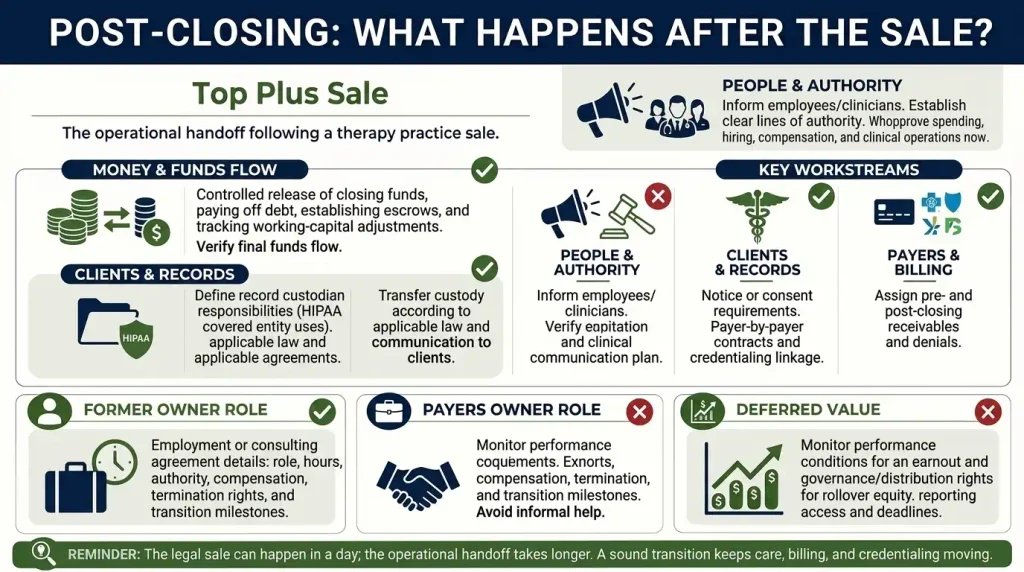
The legal sale can happen in a day; the operational handoff takes longer. A sound transition keeps care, billing, and credentialing moving while giving clinicians and the former owner clear lines of authority.
What happens after selling a therapy practice?
| Workstream | What changes | What the seller should verify |
| Ownership and authority | The buyer receives the equity or specified assets and the agreed decision rights | Who can approve spending, hiring, compensation, contracts, and clinical operations |
| Money | Closing funds move; debt, escrow, fees, and adjustments are handled under the funds-flow statement | Actual cash received, payoff evidence, escrow terms, and open true-ups |
| People | Employees and clinicians receive role, employer, benefit, or reporting information | Written offers, effective dates, retention terms, and a consistent communication plan |
| Clients and records | Custody, access, privacy, notices, and EHR responsibilities follow the transaction documents and applicable law | Record custodian, access process, psychotherapy-note controls, and migration safeguards |
| Payers and billing | Enrollment, credentialing, contracts, authorizations, remittance, and claim submission may continue or change | Responsibility by payer, billing cutoff, tax ID and NPI use, ERA/EFT routing, and unresolved claims |
| Former owner | The owner may leave, become an employee, or provide limited transition support | Role, hours, authority, compensation, termination rights, and handoff milestones |
| Deferred value | Post-closing consideration may depend on performance or a later equity event | Reporting access, calculation rules, deadlines, governance rights, and dispute procedures |
The transaction structure matters. In an equity sale, the legal entity may remain the same while its owners change. In an asset sale, selected assets and liabilities move to a buyer, often creating more contract, enrollment, payroll, billing, and records-custody work. Neither structure eliminates the need to read the closing documents alongside healthcare, employment, tax, and state-law requirements.
What actually happens on closing day?
Most modern closings occur through electronic signatures and a coordinated release of documents and funds. Counsel confirms that closing conditions are satisfied or waived. The parties sign the purchase agreement and related documents, approve a final funds-flow statement, deliver required consents and certificates, and authorize the wire transfers.
Reconcile the headline price to the amount that arrives. Separate movements may include debt payoff, expenses, escrow, working-capital adjustments, and consideration delivered as a note or equity. Independently verify wire instructions through a known contact rather than trusting an email-only change.
Operational control also needs a precise handoff time. The closing checklist should identify who controls bank accounts, payroll, billing, merchant processing, EHR administration, domains, phone systems, leases, insurance, vendor accounts, and incident response. A transition services agreement is a contract under which the seller or an affiliate temporarily provides specified services—such as billing, payroll, IT, or administrative support—after closing. It should state the services, fees, service levels, data safeguards, end dates, and exit steps rather than rely on informal help.
For the work before closing, see How to Sell a Therapy Practice. The post-closing experience is usually easier when the owner has already used a readiness process such as How to Prepare a Therapy Practice for Sale.
How should employees and clinicians hear about the sale?
The message should come from the practice, not from a rumor or an unfamiliar buyer email. Counsel should first identify any notice, consultation, benefit, labor, or contract requirements. Then the seller and buyer can plan the sequence: leadership, managers, clinicians, administrative staff, referral partners, and clients where appropriate.
Staff communication should answer practical questions without promising facts the buyer has not approved:
· When does the ownership change take effect?
· Who is the employer and direct manager now?
· Do compensation, benefits, schedules, supervision, caseload expectations, or policies change?
· Will accrued paid time off or bonuses carry over?
· What happens to clinical autonomy and escalation paths?
· Who handles payer, credentialing, technology, and privacy problems?
· What may employees tell clients and referral sources?
Give managers a written question-and-answer sheet and one escalation contact. If an answer is not settled, say when it will be. Clinicians will judge the transition through daily operating choices—scheduling, documentation, supervision, compensation, and access to leadership—not through the announcement alone.
What happens to client records and privacy after the sale?
The Health Insurance Portability and Accountability Act (HIPAA) sets federal privacy and security requirements. Protected health information (PHI) is individually identifiable health information maintained or transmitted by a HIPAA covered entity, such as a qualifying healthcare provider, or its business associate, a person or company performing certain PHI-related functions for that entity.
HHS includes the sale or transfer of assets within healthcare operations, but that does not make every disclosure or data movement unrestricted. For many healthcare-operations uses and disclosures, the covered entity must make reasonable efforts to limit PHI to the minimum necessary for the purpose. Vendors or advisors that create, receive, maintain, or transmit PHI on behalf of a covered entity may require a business associate agreement and appropriate safeguards.
The plan should identify each record custodian, the basis for transfer or access, and how clients exercise their information rights. Cover EHR migration, audit logs, backups, former-user access, breach response, and destruction. Psychotherapy notes receive special HIPAA protection, and substance-use-disorder records may trigger 42 CFR Part 2. State and professional-board rules may be more specific, so use privacy counsel.
Clients should not be described as assets that automatically transfer. Communications should preserve their ability to ask questions, obtain records, and make care choices under applicable law and professional obligations.
How do payer contracts and credentialing continue?
Do not assume that a payer contract, clinician credential, authorization, or billing enrollment follows the economics of the deal. Assignment and change-of-control language differs by payer and transaction structure. The transition team needs a payer-by-payer matrix showing required notice or consent, entity enrollment, clinician linkage, effective date, claim route, open authorizations, remittance address, electronic funds transfer, and owner of each follow-up.
For Medicare-enrolled practices, CMS tells providers and suppliers to report an ownership change within 30 days and other enrollment changes within 90 days; the correct filing and treatment still depend on provider type and facts. Medicaid and commercial-payer rules are separate and may impose different forms or timelines.
Track each service’s date, clinician, billing entity, tax ID, NPI, authorization, and claim status. Assign denials, refunds, recoupments, credit balances, and pre- and post-closing receivables. Credentialing delays can affect both cash flow and client access.
What does the former owner’s employment or consulting role look like?
A former owner may stay as an executive, clinician, consultant, or short-term transition resource. The agreement should state duties, schedule, caseload if any, reporting line, authority, compensation, benefits, liability coverage, termination rights, and handoff deliverables.
Separate employment pay from purchase consideration. If termination affects an earnout, define the result after resignation, termination, disability, or a buyer-directed role change. Avoid accountability for results without the authority, data, budget, or staffing to influence them.
A restrictive covenant is a contractual limit on conduct after the sale, such as competing, soliciting employees or clients, or using confidential information. Its enforceability depends on the language, state law, professional rules, and whether it is tied to employment or the sale of a business. As of August 30, 2026, the FTC’s 2024 federal Noncompete Rule is not in effect; the agency removed the rule in 2026 to conform to federal court decisions. That federal history does not decide a particular seller’s covenant.
How should a seller monitor an earnout or rollover equity?
An earnout is additional purchase consideration payable after closing if defined performance conditions are met. Rollover equity is the portion of value the seller reinvests in the buyer, parent, or acquisition vehicle instead of receiving as cash. Neither should be treated as cash at closing.
For an earnout, track the metric, accounting policies, measurement period, permitted adjustments, operating covenants, reporting access, delivery date, objection window, and dispute procedure. Keep the supporting reports and document how the agreement treats buyer changes to pricing, staffing, locations, service mix, or cost allocations.
For rollover equity, retain the governing agreement, capitalization details, security class, distribution and information rights, transfer limits, dilution terms, tax documents, and exit mechanics. Private equity can be illiquid, subordinated, diluted, or worth less than its closing value. Ask for the reports the documents require; do not assume public-company-style disclosure.
The related pre-signing questions are covered in Before You Accept an Offer for Your Therapy Practice.
How do leadership and culture transfer without becoming vague promises?
Start with decision rights. Name who owns clinical supervision, quality review, hiring, compensation, scheduling, payer escalation, privacy, finance, technology, and complaints. Give the incoming leader access to the people and information required for each responsibility. Set a regular transition meeting with an agenda, decisions, owners, and due dates.
Translate culture into operating facts: supervision, caseload expectations, documentation, clinician voice, scheduling, escalation, compensation, and quality review. The buyer may not preserve every practice, but staff should know what is changing and who decides.
The former owner also needs a stopping rule. Once a responsibility has transferred, employees should not be encouraged to bypass the new leader. A documented handoff protects the incoming team and reduces the chance that the seller remains the informal approval point after losing formal authority.
What tax and transaction documents should the seller retain?
Keep a secure archive of the signed agreements, disclosure schedules, funds flow, payoff evidence, wire confirmations, tax allocations, consents, insurance records, earnout calculations, rollover documents, and notices. Calendar claim deadlines, escrow releases, true-ups, and any duty to keep the selling entity active.
In an applicable asset acquisition, buyer and seller generally report the allocation of consideration on IRS Form 8594. The allocation helps determine the buyer’s basis and the seller’s gain or loss by asset. The IRS also says record-retention periods depend on the event documented, and property records generally should be kept until the limitation period expires for the year of disposition. Employment-tax records generally must be kept for at least four years after the relevant filing period.
Those federal tax periods are not a complete retention schedule. Purchase-agreement duties, state tax rules, employment law, payer requirements, insurance, litigation holds, licensing rules, and clinical-record obligations may require longer retention. Agree in writing who keeps originals, who can retrieve them, and how confidential files are protected after the seller loses system access.
What does the personal adjustment look like for the owner?
A sale can remove a routine, decision-making role, daily colleague contact, and long-held professional identity. That can coexist with relief and does not establish whether the deal was right or wrong.
Define handoff hours, stop attending meetings outside the agreed role, route staff questions to the new leader, and schedule financial, tax, estate, and insurance work. Continue professional relationships only within confidentiality, nonsolicitation, and authority boundaries.
A personal plan should identify what is ending, which obligations remain, and what will replace the structure of ownership. This is not clinical guidance. Seek an appropriately qualified professional for personal support rather than treating a transaction checklist as care.
What should the first 30, 60, and 90 days include?
| Period | Operational priorities | Seller priorities |
| Days 1–30: Stabilize | Complete communications; confirm payroll, EHR access, payer submissions, billing cutoff, leadership coverage, privacy controls, and client-contact pathways; open an issue log | Reconcile closing funds; understand the new role; deliver named files and relationships; calendar every adjustment, escrow, earnout, and notice deadline |
| Days 31–60: Transfer | Move recurring decisions to new owners; test credentialing and remittance; review staffing, denials, scheduling, authorizations, and incidents; close temporary access gaps | Complete handoff milestones; stop acting outside delegated authority; review the first financial and operating reports; document earnout questions promptly |
| Days 61–90: Normalize | Confirm permanent governance; retire temporary workarounds; measure retention, capacity, collections, and service continuity; set the next-quarter integration plan | Confirm which duties are finished; archive transaction and tax records; review rollover reporting rights; refine the personal and financial plan for the next year |
What should be on the post-closing checklist?
· Confirm every wire, payoff, escrow, and working-capital item.
· Publish one source of truth for staff questions and transition decisions.
· Name the record custodian and test client-access and release workflows.
· Maintain a payer-by-payer enrollment, credentialing, authorization, and billing tracker.
· Remove stale system access and document all temporary access.
· Put the former owner’s authority, hours, deliverables, and end date in writing.
· Calendar earnout reports, objection periods, escrow releases, and indemnification deadlines.
· Retain tax, employment, transaction, insurance, and privacy documentation under an approved schedule.
· Review clinical leadership, supervision, caseload, compensation, and quality workflows after the announcement.
· Set boundaries for the seller’s personal transition and post-sale availability.
Frequently asked questions after selling a therapy practice
Do I have to keep working after I sell my therapy practice?
Only if the documents require it or you agree to an employment, consulting, or transition role. Review duties, authority, compensation, termination, restrictive covenants, and effects on contingent payments before signing.
Who owns the client records after a therapy practice sale?
It depends on the transaction structure, contracts, HIPAA, state law, professional rules, and the records involved. The parties should identify the lawful custodian, access process, retention duties, psychotherapy-note treatment, and EHR migration plan rather than assuming all records transfer automatically.
When should clinicians and employees be told?
There is no universal date. Account for confidentiality, legal requirements, retention risk, closing certainty, and the need for honest answers. Staff should hear through coordinated communication rather than rumor.
What if payer credentialing is delayed after closing?
Follow the payer-specific transition plan and obtain counsel or credentialing guidance before billing. Do not substitute the seller’s tax ID, contracts, or credentials merely to keep claims moving. Track affected appointments, authorizations, claims, cash, and client communications while resolving the enrollment issue.
Can a buyer change the business during my earnout?
Usually the buyer controls the business, subject to the purchase agreement. Earnout terms should address operating covenants, accounting policies, cost allocations, reporting access, and remedies. Do not assume the practice will operate as before.
What happens to rollover equity when the buyer sells?
The governing documents control. A later sale may create liquidity, but distributions depend on the security class, debt, preference stack, dilution, transaction terms, and drag-along or rollover requirements. Review the actual capitalization and documents with legal, tax, and investment advisors.
How can an owner prepare for the day after closing?
The best post-closing plan is negotiated before the purchase agreement is signed. Therapy Practice Exit Report provides educational guidance so owners can understand the questions. Olympic M&A advises healthcare and founder-led business owners on sale preparation, transaction execution, and transition planning.