

Quick answer:
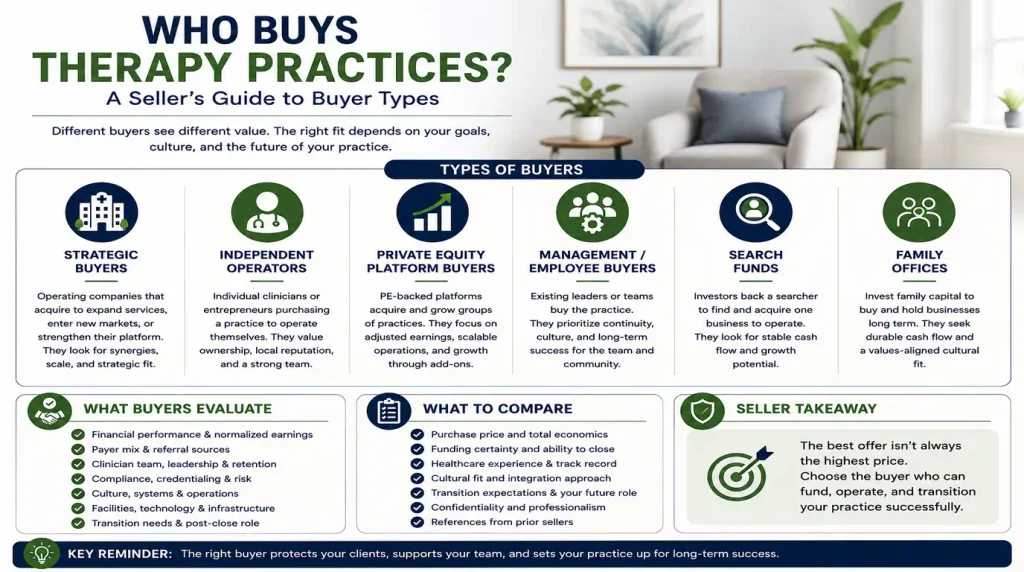
Who buys therapy practices? The most common buyer groups are strategic healthcare operators, independent clinicians or local operators, private-equity-backed platforms, management or employee buyers, search funds, and family offices. Each evaluates the same practice differently. A seller should compare not only price, but also funding certainty, healthcare experience, cultural fit, transition demands, confidentiality discipline, and the buyer’s ability to close.
A recognizable name is not the same as a suitable buyer. The practical question is not simply “Who will make an offer?” It is “Which buyer can fund, operate, and responsibly transition this particular practice?”
Who buys therapy practices, and what does each buyer want?
What is a strategic buyer?
A strategic buyer is an operating company that acquires another business to advance an operating objective. For a therapy practice, that buyer could be a regional counseling group, a multi-site behavioral-health provider, a health system, or another healthcare organization entering a service line or geography.
Strategic buyers may value clinician density, payer access, referrals, leadership, locations, specialized programs, or infrastructure. Possible benefits from combining organizations are called synergies.
Ask what the buyer actually intends to combine. Will the brand remain? Which leaders retain authority? Will compensation, caseload expectations, supervision, intake, scheduling, and documentation change? A broad promise to “preserve culture” is less useful than an operating plan.
What is an independent operator?
An independent operator is an individual or small ownership group buying without an institutional platform behind it. The buyer may be a clinician ready to lead a larger practice, an experienced local healthcare operator, or an entrepreneur with relevant management experience.
This buyer can offer personal continuity and a direct relationship with the seller. The limitations are often practical: financing capacity, healthcare operating depth, licensure or ownership restrictions, and the ability to replace the founder’s clinical and administrative work. A seller should not assume that professional credentials alone establish acquisition readiness. The buyer must also show who will oversee finance, billing, credentialing, compliance, people, and growth.
What is a private equity firm or platform buyer?
Private equity is investment capital used to acquire or invest in private companies. A platform is an operating company intended to support further growth, including additional acquisitions. A therapy practice purchased by an existing platform is commonly described as an add-on acquisition.
A platform buyer may bring acquisition experience, centralized support, capital, and a defined integration model. Its offer may combine cash at closing with an earnout, continued employment, or rollover equity—seller proceeds reinvested into the buyer’s ownership structure. Rollover equity is not cash and should be evaluated for rights, leverage, dilution, governance, information access, and the path to a future sale.
Private-equity-backed buyers differ materially. Identify the controlling fund, committed acquisition capital, approval authority, financing, and prior results. Federal merger guidance states that agencies may examine a whole series of acquisitions when a firm follows a potentially anticompetitive consolidation strategy. This does not make a given add-on unlawful; regulatory analysis cannot be reduced to deal size alone.
Can management or employees buy the practice?
Yes. A management buyout occurs when members of the existing leadership team acquire the business. An employee group may also participate directly or through a separately designed employee-ownership structure. These paths can preserve institutional knowledge, relationships, and culture because the buyers already understand the practice.
The central issue is usually feasibility. Internal buyers may need outside debt, seller financing, staged ownership, or additional equity. Roles also change: a strong clinical or operating leader does not automatically become the right chief executive, controlling owner, or borrower. Governance, decision rights, valuation, conflicts, and the seller’s post-closing involvement should be documented rather than left to trust.
How do search funds and family offices differ?
A search fund is an investment vehicle formed to find, acquire, and usually operate one primary business. The individual leading the search may become the practice’s chief executive, supported by investors. Sellers should evaluate both the searcher’s capability and the investors’ actual commitment, because the searcher may not control all required capital when discussions begin.
A family office manages the wealth and investments of a family. Some family offices buy and hold operating companies directly; others behave more like financial sponsors. Their time horizon, governance, healthcare experience, use of debt, and appetite for day-to-day involvement vary widely. “Long-term capital” should be tested through proposed documents and references, not accepted as a substitute for a transition plan.
How do therapy-practice buyer types compare?
| Buyer type | Likely source of value | Funding questions | Seller fit questions |
| Strategic operator | Geography, payer access, clinicians, services, referrals, infrastructure | Balance-sheet cash, credit facility, internal approval | What will be integrated, changed, or retained? |
| Independent operator | Established cash flow, team, brand, and an operating role | Personal equity, conventional or SBA-backed debt, seller note | Can the buyer replace the founder and lead responsibly? |
| Private-equity-backed platform | Adjusted earnings, scalable operations, add-on fit, growth potential | Fund commitment, platform cash, acquisition facility, investment committee | What are the rollover, leverage, governance, and integration terms? |
| Management or employee buyer | Continuity, inside knowledge, clinician trust, local relationships | Senior debt, seller financing, staged purchase, outside equity | Can leadership, ownership, and decision rights transfer cleanly? |
| Search fund | Stable business that the searcher can lead and grow | Investor letters, acquisition equity, lender support | Who will operate the practice, and who can approve the deal? |
| Family office | Durable cash flow, long-term ownership potential, portfolio fit | Direct family capital, debt, co-investors | What is the real hold period, governance model, and healthcare capability? |
This is a screening tool, not a ranking. Match the buyer to the practice rather than to a category stereotype.
How do buyers fund a therapy-practice acquisition?
Buyer funding may include cash, bank debt, SBA-backed debt, committed investor equity, a seller note, or a combination. An earnout defers part of the purchase price based on future results; it does not make an underfunded buyer well funded. Likewise, rollover equity changes what the seller receives and retains but does not prove that the buyer can deliver the cash portion.
The SBA lists complete or partial changes of ownership as an eligible use for its 7(a) loan program. The program operates through lenders, and the SBA states that the maximum 7(a) loan amount is $5 million. Eligibility is not approval. The buyer, business, structure, guarantors, equity contribution, collateral position, and lender underwriting still matter. SBA’s SOP 50 10 contains the governing origination policies for 7(a) and 504 loans and is revised over time.
Determine whether financing is committed, conditionally approved, or merely contemplated. Ask which purchase-price, cash-flow, owner-replacement, working-capital, collateral, and seller-role assumptions the lender reviewed.
How should a seller judge buyer fit and clinical culture?
Culture is not a vague preference. In a therapy practice, it appears in supervision, clinician autonomy, compensation, caseloads, scheduling, documentation standards, access, quality review, leadership behavior, and how difficult situations are handled. These operating choices affect retention and continuity.
Ask each serious buyer to explain the first 30, 90, and 365 days after closing. Who will speak with clinicians? Which policies change immediately? How are clinical and business decisions separated? What productivity expectations apply? What happens to benefits, remote work, supervision, intake, billing, and the brand?
Test the answer through prior sellers and leaders when available. Ask what changed, whether promised resources arrived, how disagreements were resolved, and who remained. References are evidence, not a guarantee.
Buyer fit also shapes value. Before comparing offers, establish a defensible range with How Much Is My Therapy Practice Worth? and understand why therapy-practice valuation multiples vary. A buyer’s strategic interest does not eliminate financial, tax, or execution risk.
What proof of funds should a therapy-practice seller request?
Proof of funds is evidence that a buyer can access the capital required for the proposed transaction. The right evidence depends on the funding source and stage of the process. It may include a recent bank or brokerage letter, lender prequalification or term sheet, committed-equity letter, fund documentation, or a financing plan showing each source and use.
A screenshot, generic presentation, or uncommitted expression of interest is not closing capital. Confirm the entity holding the funds, amount available, conditions, expiration, and authorized verifier while allowing unnecessary details to be redacted.
For a platform or fund, identify the acquisition entity and approval path. For a search fund, separate capital already committed from capital to be raised after an LOI. For an independent buyer, determine whether personal equity is liquid and whether the lender has reviewed this practice rather than only the buyer’s résumé.
How can a seller protect confidentiality while meeting buyers?
Use staged disclosure. Begin with an anonymized profile. Require a signed nondisclosure agreement before revealing the practice’s identity or detailed information. Release financial, workforce, payer, and contract information in layers as the buyer demonstrates interest, fit, funding, and decision authority.
Client privacy requires a separate analysis from ordinary business confidentiality. HHS includes sale or transfer of assets within healthcare operations, but HIPAA permissions carry limits and protections. HHS also requires reasonable efforts to limit many healthcare-operations disclosures to the minimum necessary. Do not place identifiable client records into a general buyer data room. Use aggregated or de-identified information where it can answer the question, restrict access by role, and involve healthcare privacy counsel before disclosing protected health information.
Advisors or vendors that create, receive, maintain, or transmit protected health information on behalf of a covered entity may be business associates, which can require written agreements and safeguards. State mental-health confidentiality rules, professional duties, payer contracts, and 42 CFR Part 2 may add requirements. A general NDA does not replace that analysis.
How do you qualify a therapy-practice buyer?
Qualification should happen before sensitive disclosure and again before exclusivity. Use this checklist:
· Acquisition thesis: Can the buyer explain why this practice fits its plan?
· Operating capability: Who will lead clinical operations, finance, billing, credentialing, compliance, technology, and people?
· Healthcare experience: Does the team understand ownership, licensure, payer, privacy, and continuity issues in the relevant states?
· Decision authority: Who can approve price, structure, diligence, financing, and closing?
· Funding: Is the equity available, and how advanced is lender review?
· Track record: Has the buyer closed comparable transactions, and will it provide references?
· Culture: Are post-closing plans specific enough to evaluate?
· Structure: Are cash, debt, working capital, earnout, seller note, rollover, escrow, employment, and transition terms clear?
· Confidentiality: Will the buyer follow staged access, privacy controls, and communication restrictions?
· Closing plan: Are diligence scope, advisors, financing milestones, approvals, and timing credible?
Red flags include pressure for client-level data before qualification, reluctance to identify funding sources, unclear decision-makers, an LOI that depends on unspecified financing, cultural assurances without operating detail, and a long exclusivity period without milestones.
Before outreach, use How to Prepare a Therapy Practice for Sale to organize the evidence buyers will request. For the full transaction sequence, see How to Sell a Therapy Practice.
How should a seller compare final buyer proposals?
Compare expected outcomes, not headline price. Model cash at closing, debt repayment, working-capital adjustments, escrow, fees, taxes, deferred consideration, rollover equity, and post-closing obligations. Then weigh funding certainty, diligence burden, consent risk, culture, transition demands, and closing record.
In an applicable asset acquisition, buyer and seller may need to allocate consideration among asset classes and report the transaction on IRS Form 8594. The IRS states that allocation determines the purchaser’s basis and the seller’s gain or loss by asset. Tax advice should come before the allocation is fixed, not after the purchase agreement is nearly final.
Frequently asked questions
Do therapy practices have to sell to another therapist?
Not always. Permitted ownership depends on entity structure, services, professional licenses, and state law. Some states restrict who may own or control a professional practice. Healthcare counsel should confirm which buyers and structures are lawful before a seller treats an offer as executable.
Which buyer type usually pays the most?
No buyer category always pays the most. A strategic or platform buyer may recognize value another buyer cannot, but price can be offset by earnouts, rollover equity, working-capital terms, employment obligations, or financing conditions. Compare complete economics and closing risk.
Is a private-equity-backed buyer the same as a strategic buyer?
Not necessarily. A private equity firm is a financial sponsor, while its operating platform may act strategically when acquiring an add-on. Ask who owns the buyer, who operates the practice after closing, and which entity is responsible for funding and obligations.
Can the seller finance part of the purchase?
Yes, through a seller note or other deferred consideration, if the parties and senior lender agree. The seller then retains credit risk. Terms should address interest, maturity, payment priority, security, subordination, defaults, remedies, and what happens if the buyer resells or refinances.
When should proof of funds be requested?
Request proportionate evidence before providing highly sensitive information and stronger evidence before signing an LOI or granting exclusivity. The exact timing depends on the process, but financing should not remain a mystery once a buyer asks the seller to stop speaking with alternatives.
Should clinicians know which buyers are interested?
Usually only people needed for the process should know early, but there is no universal communication timetable. Plan who must participate in diligence, when broader disclosure becomes appropriate, and how continuity will be explained. Balance confidentiality with retention and trust.
Can a buyer review client records during diligence?
Do not assume so. Begin with aggregated or de-identified information. Any access to protected health information must be evaluated under HIPAA, applicable state law, professional duties, contracts, and the transaction structure. Psychotherapy notes receive special protection.
Choose the buyer, not just the offer
The right process creates enough qualified alternatives to compare price, structure, culture, funding, and execution on the same facts. Therapy Practice Exit Report provides educational M&A intelligence for that decision. Olympic M&A is the transaction adviser for owners who want seller-side support.
Visit Olympic M&A for a confidential conversation about buyer strategy.